Showing posts with label Atheism. Show all posts

06 May 2012

2012 Paschal Celebrations throughout China Have Grown Exponentially

Worship at the Dormition Church-Museum on the territory of Russian Embassy in China during the Holy Week occurred daily. Rector of the Dormition Church priest Sergey Voronin was helped by cleric of Australian Diocese of the Russian Orthodox Church outside Russia, Fr Alexis Duke, and a cleric of the Orthodox Church of Czech Lands and Slovakia, Priest Igor Efremushkin.

At the Paschal liturgy more than 500 people came to pray. At the service were, in particular ambassadors and Minister-Counselors of Russia, Ukraine, Belarus, Greece, the Republic of Macedonia, diplomats from Moldova, Serbia and Montenegro. Parishioners were given the Gospel of Mark and a brochure about the Orthodox Church and church sacraments. During the liturgies of Holy Saturday and Pascha there were more than 200 communicants.

On April 22, 2012, the day of Antipascha (Saint Thomas Sunday), the Russian Cultural Center in Beijing had the Paschal celebration hosted by the Sunday School pupils of the Dormition Church.
On April 15, 2012 at St. Nicholas Church-Monument was held in Shanghai festive Paschal service, which was celebrated by the rector of the local Orthodox community Archpriest Alexei Kiselevich. Local authorities gave a permit to conduct church services, after a long delay: the last time the faithful gathered for prayer in this unique temple remaining from the first Russian emigration, was exactly one year ago. At this time, to celebrate the Orthodox Pascha, about 400 believers of various nationalities - Russian, Ukrainians, Belarusians, Serbs, Bulgarians, Romanians, Greeks, French, Dutch and others came to the church. Orthodox came from Dalian, Hangzhou, Suzhou, Nanjing, Ningbo, Guangzhou and other cities in China. Holy Communion was taken by more than 160 people. The service was attended by Consul General of Russia, Ukraine and Belarus, the leadership of the Russian Club in Shanghai. For the first time the Church could not accommodate everyone - a lot of people stood along the walls of the temple, awaiting the opportunity to venerate the icons, to go to confession, take the Holy Communion, blessing of cakes and eggs. Quite a large group of fellow countrymen during the service was forced to remain on the steps of the church and on the street. By 11 o'clock most of them due to lack of space, even moved into the roadway. Quiet Street Gaolan-lu became a piece of real Russia, and in areas adjacent to the temple one could hear primarily Russian speech. After the service a tea party was organized, there was a show of children's Paschal play, prepared by the pupils of the Sunday school "Kolosok."

Paschal services in Hong Kong were conducted by Fr Dionisy Pozdnyaev, the rector of Ss Peter and Paul Russian Orthodox Church parish. At the Paschal service there was more than a hundred people, 67 took the Holy Communion. Divine service was performed in Slavonic, English and Chinese, and the Gospel was read in an even greater number of languages.

At the services were the diplomats of General Consulates of Russia in Hong Kong and Guangzhou, as well as citizens of Ukraine, Belarus, Moldova, China, USA, France, Great Britain, Austria, Switzerland and Sweden. Among the worshipers were guests from Shenzhen, Guangzhou, Xiamen, Qingdao, Beijing, Zhuhai and Taiwan.

During Paschal evening prayers the worshippers were given the Gospel of Mark in Chinese, Slavonic, English, and Russian, published in Hong Kong by the care of parishes in Beijing, Shenzhen and Hong Kong to commemorate the 300th anniversary of the Beijing mission, and in commemoration of the Paschal liturgy. After the Paschal vespers, a concert of children's choir of the parish, was organized on the occasion of the Holy Resurrection of Christ.

During Bright Week there were Paschal services conducted in Shenzhen and Guangzhou. Worship in Guangzhou, which was celebrated by a cleric of Khabarovsk diocese Hieromonk Nicanor (Lepeshev), was attended by more than 50 people, which is considerably larger than last year.

J-List has thousands of rare products from Japan - click now

31 October 2011

Romania: On the trail of Count Dracula/Vlad the Impaler

The romantic-sounding region of Transylvania, the eastern Carpathians and their neighbouring region of Moldova (though not the Republic of that name) all lie within one country – Romania. But as we spent a week travelling around this extended section of eastern Europe we felt that, although we might indeed be geographically within one country, we were in fact traversing three separate and quite distinct emotional and historical worlds.

The first world was one of Gothic fantasy. It is epitomised by Bran Castle, with its much-vaunted connections with Vlad the Impaler – better known as Count Dracula. Other castles crowd the hilltops with their turrets and dungeons, their armouries and torture chambers. This is a world in which Ludwig II – the mid-19th-century mad king of Bavaria – and Wagner would have felt at home.

The periodical rumble of thunder and flashes of lightning seem a natural backdrop to its dark coniferous forests, still alive with wolves and the occasional brown bear. Occasional encounters with light-fingered gipsy gangs lend a frisson of danger to the unwary traveller – as we were to discover during our travels. The swans on the moonlit lakes look as if they might at any moment transmogrify themselves into ballerinas in search of a lovelorn prince.

The second world is a more wholesome one of Saxon villages and simple peasant agriculture. Horse-drawn carts trundle slowly along the lanes; small old-fashioned haystacks line the fields and punctuate the horizons; smiling old men scythe in the fields and decoratively dressed women fork up the hay; poppies and other wild flowers enliven the meadows; wooden Saxon houses with their high gates and brightly coloured exteriors line the village streets; every telegraph pole seems to support a nesting crane newly arrived from Africa. This is the world beloved of Prince Charles, who has bought a manor house in the region. It is no longer Wagner's world, but rather that of The Sound of Music.

The third of the worlds through which we passed is a ghost world of the former Romania of Nicolae Ceausescu and the communist era. Much has been done in the past two decades to remove the ugly traces of that unhappy chapter in Transylvania's history. Hotels have had massive makeovers; no longer do they look as if they are awaiting party delegations, and are instead alive with young people dancing at wedding breakfasts; but still bath plugs tend to be absent and loo seats tend to be wobbly; credit card machines tend to be non-functional; and one is tempted to ask the occasional receptionist whether she got a refund from charm school.
Away from the hotels, too, there is indestructible evidence of the insensitive state planning of the Ceausescu years: tyre factories belching dark smoke have been dumped down in areas of outstanding natural beauty; a vast cement works intrudes on a spectacularly beautiful mountain gorge; in some places, ribbon development stretches along highways for mile after mile, blanketing the road from the glorious surrounding countryside. Old practices from the hard years die hard: it still seemed safer to our driver to fill up his car in a sizeable urban petrol station than risk the contamination of a wayside pump, and everywhere people were still smoking like chimneys.

My wife and I had made our plans carefully in advance, and were met at Bucharest airport by our guide, who was also the driver of the comfortable Mercedes that was to transport us for the following week around a route which dipped in and out of all the varied worlds described above. We set out northwards straight for the hills, our first night being at Sinaia (a town and monastery named after Mount Sinai by a returning pilgrim in the Middle Ages).

The next morning our first port of call was Peles Castle, a fairy-tale creation built as the summer residence of King Carol I in the late-19th century. Our arrival coincided with a rally of vintage cars which gave an agreeably Belle Époque atmosphere to the park and surroundings. Inside, the atmosphere was more military: vast arrays of armour and weapons adorned the walls, including an executioner's sword, the blade of which was inscribed "may God forgive the villain whose head this will sever".

Our next stop was Bran Castle, supposed abode of Prince Vlad Tepes – the prototype for the mythical Count Dracula. There is no doubt that Vlad was – even by the standards of the 15th century – an exceptionally cruel ruler, impaling rather than beheading his enemies, though not – like Dracula – drinking their blood. He was something of a hero in his time, as he led a stout resistance to the Turkish invaders. But it is the gruesome aspects of his legend which now haunt his castle: vampire masks, blood-red wine and wooden daggers jostle for prominence in the market below the castle.

Inside the castle, winding spiral staircases and low cavernous doorways increase the sense of menace. One feels one could drop into an oubliette and disappear forever at any moment. Our visit coincided here not with vintage cars but with a coachload of Romanian schoolgirls. This seemed to upset the castle guide, and when I asked him why, he said it meant he could not use the joke he liked to make to tourists: "Dracula only drinks the blood of young virgins: you will all be safe!" This lot, he said, were certainly young, and he hoped they were virgins.

We concluded our day at Brasov, visiting two churches. The Black Church – so called because it was burned and largely rebuilt in 1689 – houses one of the largest and finest organs (440 pipes) in Europe, and also a collection of Turkish rugs draped over pews and choir stalls as if for sale, but which were in fact permanent furnishings serving as a reminder of the intercourse with the Ottoman Empire. The painted pew fronts depict the role of the various civic guilds with whose wealth the church was built.

At our second church – that of St Nicholas – we were met by an elderly professor who took us to the library in the precincts, which contains a remarkable collection of early-Christian books and manuscripts. So sensitive were these in the Stalinist period (the town had been renamed after Stalin in the Fifties – a fact not often mentioned now) that the professor had hidden them away in the church tower to prevent their destruction. As he turned over the pages, he remarked wistfully how odd it was that Romania (an Orthodox country) had adopted the Latin/Roman rather than the Cyrillic script. I found myself wondering about the risks this dedicated scholar must have run in hiding away his precious Christian evidence from Stalin's henchmen.
Another day, another place. Sighisoara is a medieval fortress town which is now a Unesco world cultural heritage site. There is a bizarre legend that its Saxon inhabitants are descended from the children of Hamelin who were led away from home by the Pied Piper. Its charming square, with its brightly painted houses and welcoming cafés, is certainly part of that second world of gentle Saxon rural life. But it also turns out to have been the birthplace of Vlad the Impaler, and its clock tower (another steep rickety climb) is flanked by a torture chamber displaying gruesome instruments of the trade: the world of Gothic horror is never far away.
Continuing our journey, we made a short diversion to a quintessentially Saxon village, where we were able to see Prince Charles's manor house overlooking as peaceful a scene as could be found anywhere in central or Eastern Europe. But again, the Gothic drama was not far below the surface: when we stopped for my wife to wander off alone to take a photograph of a passing hay wain, she was set upon by a group of gipsy lads, one of whom attempted to snatch her camera and push her into a ditch, while another waved a scythe menacingly; she extricated herself – scratched, bleeding and slightly disillusioned. It was as if the evil baron of Swan Lake had suddenly appeared on the set of The Sound of Music.

Sibiu, our next staging post, was declared the European capital of culture in 2007. Its labyrinth of medieval squares, churches, bridges and narrow streets seemed to justify the award. We were particularly careful how we answered questions while standing on the Liar's Bridge, since we were assured than any untruth uttered on the bridge would cause it to instantly collapse; in Transylvania it seemed unwise to disregard such superstitions.

In the nearby village of Sibiel, we visited a museum of icons painted on glass; despite their age, many of them were almost Picasso-like in their modernity, but all managed to convey a reverence for their sacred subjects. In the same village, we were invited to dinner in a Saxon house belonging to a friend of our guide, where a collection of meat balls were washed down with generous quantities of plum brandy.

From Sibiu to Bucovina, the region of the famous painted monasteries, was a long drive of some 300kms (186 miles) passing through the eastern Carpathians and the dramatic Bicaz Gorges and skirting the Lacu Rosu (or Red Lake). This was the scenery that most romantic visitors to Transylvania had been hoping to encounter: the dense pine forests sloping steeply into ravines bordering the road are – we were assured – still the habitat of wolf packs and brown bears of the sort that had chased Nicholas Crane when he walked through the region in the Nineties. If a comfort stop required a wander into the dark trees, we were careful not to go too far into this Wicked Wood.

The monasteries themselves, when we reached them, were worth every one of the 300kms. Voronet Monastery is known as the Sistine Chapel of the Orthodox Church on account of its spectacular ceiling and wall frescoes; but the exterior walls are also a visual delight of early 16th-century imagination. Not all the murals depict the normal biblical scenes; one, for instance, shows a line of Turkish dignitaries queuing up (like passengers at Heathrow) to be sent down to hell. This is not altogether surprising when it is remembered that the monastery was built by Prince Stephen the Great of Moldova (1457-1504), the renowned Hammer of the Turks. Moldovita Monastery was built by Stephen's son and – true to form – shows Turks decapitating lines of haloed Christian saints. At the Sucevita Monastery, a nun explained one of the murals to us; a child was being restored to her mother by St Nicholas; we asked innocently how he had come to be parted from her and the answer was predictable – kidnapped by the Turks. One is not allowed to forget that this was indeed the front line of Christendom for several centuries.

Surprisingly unsated by churches, castles, haystacks and forests, we eventually headed south to Bucharest airport and home. As we dozed off on the plane, we had gentle memories of a sunlit land of calm medieval pastures and homesteads; we had disturbing dreams of vampires looming down on us from crenellated ramparts; and we had a gratifying sense of having seen a land successfully lifting itself out of decades of communist drabness. But I'm not sure that if I had been leaving from London rather than Bucharest, my wooden Dracula dagger (for my grandson) might not have been confiscated as a threat to airline security.

J-List has thousands of rare products from Japan - click now

26 October 2011

Taoism: remedy for a world in crisis?

From environmental protection to crime prevention, Taoist priests, scholars and dignitaries on Tuesday called for building a harmonious world by using the ancient wisdom of Lao Tze, a Chinese philosopher who lived over 2,500 years ago.

During the three-day International Taoism Forum, which closed in central China's Hunan Province on Tuesday, about 500 delegates from more than 20 countries and regions, including China, the United States, France, Spain, Germany, Italy and Japan, exchanged thoughts on how to integrate Lao Tze's philosophy into modern society in an effort to solve existing problems such as war, terrorism and financial crises.

A declaration issued at the closing ceremony called on people around the world to "achieve serenity of body and mind, peaceable human relationships, environmental harmony and sustainable development," as conflicts grow rife and the natural world is disturbed due to the unchecked desires of man.

A SIMPLE LIFE

The 1,800-year-old religion of Taoism originated from Lao Tze's (BC 571-471) book "Tao Te Ching," in which he postulated that everything in the universe was born from emptiness and that balance and harmony should be achieved between human beings and nature.

Taoism was all but wiped out during the chaotic Cultural Revolution (1966-1976) and resumed after China's reform and opening-up to the outside world in the late 1970s. Recent statistics show that there are nearly 100,000 Taoist priests and over 5,000 Taoist religious sites on the Chinese mainland.

During the forum, religious figures and philosophical experts lashed out at the greed of modern people, saying that their behavior has led to natural degradation.

"The destruction of the natural environment -- often done today in the pursuit of wealth -- has gathered force in the past hundred years and is now like a runaway train," said Martin Palmer, secretary-general of the U.K.-based Alliance of Religions and Conservation.

"To me, the global financial crisis was caused by nothing other than the greed of Wall Street," said Liu Changle, board chairman and CEO of Hong Kong-based Phoenix Satellite Television.

Delegates also expressed concerns over moral degradation in Chinese society. Earlier this month, a two-year-old girl was ignored by 18 passersby after she was run over by two vans and left to bleed on a street in the city of Foshan in the wealthy southern province of Guangdong. The injured girl died in a hospital last Friday, sparking a nationwide debate on the country's moral standards.

"In a market economy, some people blind themselves with materialist desires and pursue nothing but profits. It is causing a moral, psychological and social crisis for China," said Professor Xu Kangsheng from the Department of Philosophy of Peking University.

"Many Chinese are occupied with pursuing fame and fortune, only to end up with an exhausted and uneasy mind," said Huang Zhijie, vice president of the Chinese Taoist Association.

Delegates called for promoting Taoist wisdom as a possible remedy, as the belief system holds that greed is the root of all hatred, killing and war.

"Taoism asks people to pursue a simple, but correct lifestyle, and to jettison excessive desires and choices," said Ge Rongjin, a philosophy professor from Renmin University

He said a return to Taoist tranquility could help people relax and calm their minds, allowing them to find the "right path."

Palmer said that to many in our contemporary world, extravagant wealth is the main goal and greed feeds on the desire to have the best of everything and to show it off to the rest of the world.

"But Taoism goes in the opposite direction. Simple living is the heart of the Taoist way of life. And it is a joyful simplicity," he said.

TAOISM GOES GLOBAL

The forum, co-sponsored by the Chinese Taoist Association and the China Religious Culture Communication Association, is a continuation of the International Forum on Tao Te Ching held in Xi'an and Hong Kong in April 2007, bringing Taoists from all over the world to discuss their beliefs.

"The philosophy Lao Tze wrote 2,500 years ago is still alive today," said Herve Louchouarn Trestard, a Mexican doctor and president of the Mexican Taoist Association.

Nevertheless, compared with Buddhism, Christianity and Islam, Taoism has yet to develop into a global religion, although modern international communities are starting to realize the practical significance of Taoism and Lao Tze's thoughts.

In 1995, the British Taoist Association was founded in London, making it the first Taoist group in Europe. In 2001, the Spanish Taoist Association was founded and the first Taoist temple in Europe, the Qing Jing Gong, was established in Barcelona in the same year.

The number of Taoist disciples in Europe and North America has been on the rise over recent years, with Taoist associations established in several countries, including the United States, France, Portugal and Italy.

Ong Seng Huat, director of the Taoist Culture Research Center in Malaysia, believes that Taoism should develop into a world religion because the Tao Te Ching and Lao Zi's thoughts had a "global perspective" from the very beginning, which has allowed Taoism to transcend countries, regions and races.

He suggested that Taoists should set up more organizations and engage themselves in more international talks and activities in order to contribute more to the international community.

"It is time for Taoism to grow. Because it can help not only people in China, but also people in the West," Trestard said.

J-List has thousands of rare products from Japan - click now

15 October 2011

Kyakhta: The Russian source for all the tea in China

One of the most dramatically picturesque areas in the Russian Federation is located in the Republic of Buryatia along the northern border of Mongolia. The dry, clear air provides endless vistas of plains with sparse cover giving way to rolling hills with pine forests. The area was once dotted with Buddhist monasteries, very few of which still exist in places such as Gusinoe ozero (Goose Lake), itself a remarkable body of cerulean water nestled among the hills.

The main hub of human activity in this area is the town of Kyakhta, for centuries the main border crossing for trade between Russia and China. Located about 150 miles south by road from Buryatia’s capital Ulan-Ude, Kyakhta was originally an aglomeration of three settlements dating from the early 18th century that served to regulate trade and customs between Russia and China. Situated by the small Kyakhta River, the settlement was on the most direct caravan route between the Siberian center of Irkutsk and Beijing. In 1727, work began on the New Trinity Fort, founded by Count Savva Vladislavich-Raguzinsky and named after its Church of the Trinity. Later that year, the Russian and Chinese Empires signed treaties formalizing the border and establishing trade relations. In 1805 the settlement around the fort was designated a town named Troitskosavsk in honor of the two altar dedications of its main church (Trinity and St. Savva).

While the Trinity Fort fulfilled administrative and security functions, trade was handled by the adjacent settlement of Kyakhtinskaya Sloboda (Kyakhta Quarter), also founded in 1727. Here Russian merchants gathered to trade fur, leather, hides and cattle for a variety of Chinese goods, including silk and some porcelain, but with special emphasis on spices such as ginger and rhubarb, which were highly valued for medicinal properties. By the 1760s, Kyakhta Quarter had become the primary border point for trade with China, and the population and prosperity of both Russian settlements increased accordingly. Chinese merchants gathered across the border in a third settlement, known as Maimachin—a generic Chinese term meaning “trading center.”

By the late 18th century, the most significant import by far was tea, which for almost a century Kyakhta provided not only to the enormous Russian market, but also to much of Europe. Some of the buildings constructed to handle the tea trade still stand in various conditions, including the main Merchants’ Court, located near the Resurrection Church. Within its large rectangular courts, bales of Chinese tea were repackaged for shipment west.

During the first century of Kyakhta’s existence, all its structures were built from logs. As the 19th century progressed, however, the log churches were replaced with large masonry churches in a neoclassical style, a move that reflected the town’s increasing prosperity. The most notable of these churches was the Cathedral of the Trinity, begun in 1812 with the support of donations from local merchants and completed in 1817. A major expansion of its refectory in 1870 gave it an appearance that more closely resembled western churches, rather than the typical Russian Orthodox design. Closed during the Soviet period and converted to a museum in 1934, the cathedral was gutted by fire in 1963. Its bare walls still stand as an imposing classical ruin.

Not to be outdone by the reconstruction of the cathedral in Troitskosavsk, in the 1830s, merchants in the Kyakhta trading quarter paid for the construction of an imposing new Church of the Resurrection, built according to a design by the Moscow architect Grigory Gerasimov. With the completion of the church and the dedication of its three altars in 1838, this dusty border town could claim two of the most impressive churches in the Transbaikal region, a tribute to its commercial significance for the China tea trade. And in 1884-1888 the Cemetery Church of the Dormition was constructed to replace an adjacent log church

Perhaps the greatest charm of Kyakhta is its individual houses, which are built primarily of wood. With a minimum of maintenance, they have been relatively well preserved in the area’s dry climate. One of the few large masonry houses in the town belonged in the mid-19th century to the philanthropist Alexei Lushnikov, of a family known not only for its support of culture and philanthropy, but also for hospitality. The many guests to visit the Lushnikov house include the renowned American traveler and author George Kennan.

With the opening of Chinese ports to English ships in the mid 19th century and the subsequent building of the Suez Canal, Kyakhta’s importance to the tea trade waned. Its importance was further diminished by the town’s distance from any rail link. Nonetheless, Kyakhta retained regional importance for trade with northern China.

Like so many Siberian towns, Kyakhta suffered from the savagery of the Russian Civil War. Between 1918 and 1921, the town was fought over by numerous factions, and at the same time played a role in the establishment of Communist forces in Mongolia. As a final blow, the town was attacked in the spring of 1921 by troops led by the notorious Baron Ungern-Sternberg. Although the attack was repulsed by Soviet forces, the fighting in 1921 led to the complete destruction by fire of the once-thriving Chinese settlement of Maimachen.

In 1934, the various settlements were officially designated by the single name of Kyakhta. During the Soviet period, the town shifted roles to administrative and military garrison duties. Today, Kyakhta is a placid border crossing with a population less than 20,000. It has visions of expanding its economy through tourism, including eco-tourism to Mongolia. In this role, perhaps its greatest blessing is to have been bypassed by development, still appearing much as it did when it was the departure point for “all the tea in China.”

J-List has thousands of rare products from Japan - click now

01 October 2011

Orthodox Christianity in Harbin

Orthodoxy arrived in China in 1685, more than a century earlier than the first Protestant missionaries. Intermittent border skirmishes in the Amur River area between troops of the Qing Emperor and the Czar resulted in some Russians being taken prisoner. A priest by the name of Maxim Leontiev was among the prisoners taken in 1685 to Beijing. The Russo-Chinese accord of Nerchinsk in 1690 settled disputes but some of the released prisoners decided to stay in China as naturalized citizens. The Kangxi (Kang Hsi) Emperor gave a Guandi (Kwan Ti, the god of war) temple to them as a temporary place of worship in Beijing, and the Orthodox named it the Hagia Sophia Church. An icon of St Nicholas the Wonderworker was placed in the church, which was subsequently renamed the Church of the Dormition. The Emperor also gave Father Leontiev the title of an imperial official of the seventh rank.

The Russian Government and Russian Church took notice of the Kangxi Emperor’s consideration. In 1695 the Metropolitan of Tobolsk issued documentation recognising the consecration of the Hagia Sophia Church and encouraged Father Leontiev to work for the spread of Orthodoxy, and to “pray not only for the Czar, but also for the Chinese Emperor”. Czar Peter I (“the Great”) was from the beginning an enthusiastic supporter of the Orthodox Church’s work in China. When Father Leontiev died, Peter the Great obtained the Kangxi Emperor’s consent for Archimandrite Ilarion Lezhaisky to take over in Beijing. The Archimandrite arrived in Beijing in 1715 with a priest, a deacon and other staff. This was the first Spiritual Mission of the Russian Orthodox Church in Beijing.

There were to be 20 tours, or delegations, of the Spiritual Mission in Beijing, from 1715 through 1956, when Archbishop Viktor returned to Russia following agreements reached between Nikita Khruschev and Mao Zedong (Mao Tse-tung). Throughout the period of the Czars, the Spiritual Mission worked closely with the Russian Government, often seeing a close relationship between the furtherance of Russian interests and Orthodox interests.

In the first century-and-a-half of its presence in China, the Spiritual Mission did not attract a large following. It is said that in 1860 there were not more than 200 Orthodox in Beijing, including the descendants of naturalized Russians.

In the second half of the 19th century, however, the Orthodox Church made bigger strides. The Spiritual Mission was blessed with scholarly and religious clergy. Numerous translations into Chinese of religious publications were made. By 1902 there were 32 Orthodox churches in China with close to 6,000 adherents. The church also ran schools and orphanages.

The Boxer Rebellion of 1898 - 1900, an anti-Western and anti-missionary uprising in China, saw violent attacks on Chinese converts to Christianity. The Orthodox Chinese were among those put to the sword, and in June every year we commemorate the 222 Chinese Orthodox, including Father Mitrophan, who died for their faith in 1900 during the upheavals.

After the Russian Revolution of 1917 the Orthodox Church in China lost its traditional support base and had to fend for itself. Any investments it made in the Czar’s bonds became valueless. However it became the spiritual home of large numbers of anti-Bolshevik Russians who left Russia for China, and the numbers of Orthodox in China swelled. By around 1930 there were more than 50,000 Orthodox in China, mostly Russians. Dioceses were established in Shanghai and Tianjin in addition to Harbin and Beijing.

After the October Revolution the Orthodox bishops in China came under the jurisdiction of the Synod of Russian Bishops Outside Russia, convening in Karlovci, Yugoslavia, and subsequently in Munich and New York. The surrender of the Axis powers at the end of World War II gave rise to a change in the situation in the Far East, and the Moscow Patriarchate resumed jurisdiction over the episcopate in China in the late 1940’s.

The Chinese People’s Republic was established in 1949 under the leadership of the Chinese Communist Party, which had close relations with the Soviet Communist Party in the 1950’s. Treaties were signed between the Chinese and Soviet governments which provided for the turning over of Russian churches to Chinese control. Archbishop Viktor, the last Russian bishop and leader of the 20th Spiritual Mission, returned to the Soviet Union in 1956, drawing to a close a variegated chapter in the history of Orthodoxy in China.

After the communists came to power in China most of the Russians left for Australia, the United States and other places. Now there are very few Russians left in China, and the numbers of the Orthodox from the old Russian-organised dioceses have dwindled drastically. There is only one functioning Orthodox church on the Mainland - the POKROV church (the church of the Protection of the Theotokos) in Harbin. The resident priest, Father Grigori Zhu, is 75. There are about 18 parishioners who attend Sunday services, most of them elderly. The youngest is 65. Yet on the great feast of Easter this year, about 400 people filled the church - many who have settled overseas, and their children, returned to the mother church in Harbin for Pascha.

Pascha is the central message of Christianity. God brings life out of death. What man or human organizations plan could never get around or defeat God’s plan. Perhaps there were people who expected, or even wanted, to see a dying Orthodox church in China. After 1997 this has totally changed.

J-List has thousands of rare products from Japan - click now

30 September 2011

My Home: Harbin, Heilongjiang in the Heat

Thousands of tourists flock to Harbin in January, drawn by the fantastical statues on show in the town's international ice and snow festival. In September though, winter is still a couple of months away and there's no sign of the white fluffy stuff that has made the capital of Heilongjiang province in northeastern China famous. Well, except that is, for an ice sculpture of a dolphin on a table in busy Central Street.

It's 20 degrees Celsius today and hot looking girls along with the rapidly melting dolphin are probably wishing they could cool off in the venue they're promoting - the Ice House, located in the basement of a nearby building, apparently a precursor to the winter's "city of ice".

Elsewhere in town, local government is aggressively promoting Harbin as a summer resort, highlighting its diverse wetlands as well as its culture.

"Harbin has a rich historical heritage," says Wang Yi, the city's lady vice-mayor who is in charge of tourism development. "It is a city where the east meets west and it offers a blend of oriental and Western cultures."

Indeed, Harbin is like no other Chinese city with architecture that clearly shows Russian and European influences and has you thinking for a while that you're in eastern Europe. Central Street, the 1.4-kilometre stretch in the city's business district, is lined with buildings of Baroque and Byzantine styles.

The cobblestone pedestrian street is part of the original town built by the Russians at the turn of the 20th century when they first came to the then sleepy fishing village along the Songhua river to construct the Chinese Eastern Railway. Today, the buildings house restaurants, brand-name stores and souvenir shops that sell all things Russian like matryoshka dolls and vodka.

The Russian Orthodox Church Saint Sophia Cathedral escaped destruction during the Cultural Revolution and was used as a warehouse for a state-run department store. The church was restored in 1996 after the Chinese government designated it as a national cultural heritage site and is now a museum showcasing the multicultural architectural development of the city.

Saint Nicholas Cathedral wasn't quite so lucky: it was destroyed by the Red Guards in 1966. A rich businessman, Wang Fu Xiang, decided to build a replica of the church in Volga Manor, a resort about an hour and a half away from the city.

Volga Manor offers a Russian experience from the traditional welcome that greets guests on arrival to the 30 buildings scattered all over the compound, including a replica of the Pavlov Castle.

One of the biggest programmes in Harbin is the ongoing restoration of the Chinese Baroque Block. The project, which covers 10 zones, features the unique Baroque facade that hides the two to three storey-structures inside and a backyard resembling Beijing courtyard houses. The redevelopment is costing 1.3 billion yuan (S$262 million) and the buildings are being earmarked for arts, tourism and movie studios.

Harbin also has something to offer for nature lovers like the Binjiang Wetland, which opened in June. It covers an area of 104 square kilometres and has hundreds of rare species of birds and fish such as grey cranes and white cranes.

The guides are former farmers who used to grow rice and wheat on the land. According to the government, it will take at least three years to fully develop the wetland into a full-fledged ecological and leisure development zone.

Sun Island Park on the north shore of the Songhua river, is also worth a visit. It offers many attractions like the Squirrel Island, Deer Park, Swan Lake and Flower Park.

There is also a Russian village that offers visitors an idea on how Russians lived in Harbin. The highlights include life-sized Matryoshka dolls painted to look like leaders Vladimir Putin, Boris Yeltsin, Mikhail Gorbachev, Stalin and Lenin.

Across the river, an opera house is being built that promises to be much grander than the one in Sydney. The river is frozen during the winter months and it is here where Harbin's world-renowned ice and snow festival is held. In September, however, it's just water and sand.

At the entrance to the park is a giant structure of the sun, surrounded by nine smaller suns. According to Chinese myth, during the Chou dynasty (1027-221 BC), 10 suns would take turns appearing in the sky. Each day, they would travel with their mother, the goddess Xi He, to the lake where she would wash her children and put them to dry on the branches of an enormous mulberry tree.

From the tree, one sun would move off into the sky for a journey of one day, to reach the mount Yen-Tzu in the Far West. Then, one day, the suns decided to appear together. But the combined heat of the 10 suns made life on the Earth unbearable. Emperor Yao asked Di Jun, the father of the 10 suns, to persuade his children to appear one at a time. The suns refused not listen. Di Jun sent the archer Yi armed with a magic bow and 10 arrows to frighten the disobedient suns. Yi was able to shoot nine suns but the emperor had sent one of his couriers to steal an arrow from the archer. So one sun remains today.

"This is how the sun looks like in Chinese myth," says our guide, pointing to the giant sculpture that has three legs and a bird on top of its head.

Proof, as if it were needed, that Harbin is not all about snow. A hot sun shines there too.

J-List has thousands of rare products from Japan - click now

24 September 2011

Korea: Leaders of South Korea’s 7 Religions visit the North

The leaders of South Korea’s seven major religions arrived yesterday in the northern part of the peninsula: it is an unprecedented journey that seeks to bring the two sides of the border to the path of peace and reconciliation. But some Catholic sources, while praising the action, explain: "The communist regime in Pyongyang has no intention of being open to religion. It only needs humanitarian aid, and knows it can get it through religious communities. "

The delegation consists of 24 people who reached North Korea via China, since there are no direct links between the two parts of the peninsula. The trip was organized at the invitation of North Korean Council of Religions, a puppet in the hands of Pyongyang that provides "sham" functions for the few Western and Chinese tourists who arrive in the country. In any case, this is a unique opportunity: the delegation will remain in the country until Saturday, September 24.

Leaving the international airport of Incheon, Gwangju Archbishop Mgr. Hyginus Kim Hee-jong read a joint statement given by all religions: "We will deliver South Korean religious groups’ aspirations for peace to the North. As the religious people from the two Koreas gather to reaffirm our resolve to achieve peace, we hope that the minds of the two Koreas will become united in our pursuit of reunification, and that this will contribute to opening a new history of reconciliation, cooperation and exchange". The group also thanked the Seoul government for having granted permission to leave. After the military provocations of Pyongyang, in fact, the government has prevented almost any relationship between the two countries.

Along with Mgr. Kim are the Rev. Kim Yeong-joo, Secretary of the Korean National Council of Churches, the Venerable Jaseung, president of the Korean Jogye Order of Buddhism, Ven. Kim Ju-won, who leads Won Buddhism; Dr. Choi Geun-dok, president of the Confucian Sung Kyun Kwan Association, Woon Yim-kil, head of the Chondogyo and Han Yang-won, who heads the Korean traditional religions.

Although born of good intentions, a Catholic source tells AsiaNews: "Pyongyang has no desire to be open to the idea of religion in a straightforward manner, because the regime would fall after a few months if it did. Religion, first of all, teaches freedom and does not fit well with the dictatorships. For this reason, even if it is right to see and experience the situations as much as possible, I think it is a lure to get as much humanitarian aid as possible from the religious people of the South ".

In the North, there is virtually no freedom of worship. The only cult allowed is the worship of the "Dear Leader" Kim Jong-il and his father, the "eternal president" Kim Il-sung. Society is organized into hierarchical levels, and those who profess a religion are relegated to the bottom. However, it was not always so: before the independence of the North, obtained thanks to Chinese weapons supplied by Mao, Pyongyang was called "the Jerusalem of Asia".

There was a very strong presence of Christians in the country, Catholics and Protestants, who contributed greatly to the social development of Korea in the early 1900s. The presence of Buddhists was also strong, of course, both that of the traditionalists and Jogye Order, even the Orthodox Church had a good number of followers, as well as shamanism and traditional worship.

President Kim’s crackdown on the religious and faithful of all kinds devastated everything. It is impossible today to quantify the number of people who have maintained some form of faith. According to the Vatican, there would still be about 800 Catholics present: AsiaNews sources claim that their numbers arrive "at most" at two hundred, all very old.

J-List has thousands of rare products from Japan - click now

18 May 2011

Apophatic Theology

Apophatic theology (from Greek ἀπόφασις from ἀπόφημι - apophēmi, "to deny")—also known as Negative theology or Via Negativa (Latin for "Negative Way")—is a theology that attempts to describe God, the Divine Good, by negation, to speak only in terms of what may not be said about the perfect goodness that is God. It stands in contrast with Cataphatic theology.

In brief, negative theology is an attempt to achieve unity with the Divine Good through discernment, gaining knowledge of what God is not (apophasis), rather than by describing what God is. The apophatic tradition is often, though not always, allied with the approach of mysticism, which focuses on a spontaneous or cultivated individual experience of the divine reality beyond the realm of ordinary perception, an experience often unmediated by the structures of traditional organized religion or the conditioned role playing and learned defensive behavior of the outer man.

In negative theology, it is accepted that the Divine is ineffable, an abstract experience that can only be recognized or remembered—that is, human beings cannot describe in words the essence of the perfect good that is unique to the individual, nor can they define the Divine, in its immense complexity, related to the entire field of reality, and therefore all descriptions if attempted will be ultimately false and conceptualization should be avoided; in effect, it eludes definition by definition:

Neither existence nor nonexistence as we understand it in the physical realm, applies to God; i.e., the Divine is abstract to the individual, beyond existing or not existing, and beyond conceptualization regarding the whole (one cannot say that God exists in the usual sense of the term; nor can we say that God is nonexistent).
  • God is divinely simple (one should not claim that God is any type of being.)
  • God is not ignorant (one should not say that God is wise since that word arrogantly implies we know what "wisdom" means on a divine scale, whereas we only know what wisdom is believed to mean in a confined cultural context).
  • Likewise, God is not evil (to say that God can be described by the word 'good' limits God to what good behavior means to human beings individually and en masse).
  • God is not a creation (but beyond that we cannot define how God exists or operates in relation to the whole of humanity).
  • God is not conceptually defined in terms of space and location.
  • God is not conceptually confined to assumptions based on time.
Even though the via negativa essentially rejects theological understanding as a path to God, some have sought to make it into an intellectual exercise, by describing God only in terms of what God is not. One problem noted with this approach, is that there seems to be no fixed basis on deciding what God is not, unless the Divine is understood as an abstract experience of full aliveness unique to each individual consciousness, and universally, the perfect goodness applicable to the whole field of reality. It should be noted that this is also a kind of definition, namely that the Divine is an experience, which - because of the very defintion of apophatic theology - the then Divine cannot be.

The ancient Greek poet Hesiod has in his account of the birth of the gods and creation of the world (i.e., in his Theogony) that Chaos begot the Protogenoi: Eros, Gaia (Earth) and Tartarus, who begot Erebus (Darkness) and Nyx (Night), and Plato echoes this genealogy in the Timaeus 40e, 41e where the familiar Titan and Olympian gods are sired by Heaven and Earth. Nevertheless, Plato is far from advocating a negative theology. His Form of the Good (identified by various commentators with the Form of Unity) is not unknowable, but rather the highest object of knowledge (The Republic 508d-e, 511b, 516b).

Plotinus advocated negative theology in his strand of Neoplatonism (although he may have had precursors in Neopythagoreanism and Middle Platonism). In his writings he identifies the Good of the Republic (as the cause of the other Forms) with the One of the first hypothesis of the second part of the Parmenides (137c-142a), there concluded to be neither the object of knowledge, opinion or perception. In the Enneads Plotinus writes: "Our thought cannot grasp the One as long as any other image remains active in the soul…To this end, you must set free your soul from all outward things and turn wholly within yourself, with no more leaning to what lies outside, and lay your mind bare of ideal forms, as before of the objects of sense, and forget even yourself, and so come within sight of that One."

The Arabic term for "Negative theology" is Lahoot salbi, which is a "System of theology" or Nizaam al lahoot in Arabic. Different traditions/doctrine schools in Islam called Kalam schools use different theological approaches or Nizaam al lahoot in approaching God or the ultimate reality. The Lahoot salbi or "Negative theology" involves the use of ta'til, which means "negation," and the followers of the Mu'tazili school of Kalam, founded by Imam Wasil ibn Ata, are often called the Mu'attili, because they are frequent users of the ta'til methodology.

Shia Islam is another sect that adopted "Negative theology". Most Salafi/Athari adherents reject this methodology because they believe that the Attributes of God, as depicted in Islamic scriptures is to be literal. But most Sunnis, who are Ash'ari and Maturidi by Kalam use ta'til to some extent, if not completely. The Sufis greatly depend on the use of ta'til in their spirituality, though they often also use Cataphatic theology.

Perhaps the most widespread use of Negative theology occurs in the Hindu scriptures, mainly the Upanishads, where Vedantic theologians speak of the nature of Brahman - Supreme Cosmic Spirit as beyond human comprehension. “Whenever we deny something unreal, it is in reference to something real.” [Br. Sutra III.2.22].

The Taittiriya hymn speak of Brahman as 'one where the mind does not reach'. Yet the scriptures themselves speak of Brahman's positive aspect also such as, "Brahman is Bliss". The idea of using these contradictory descriptions is to show that the attributes of Brahman is "similar" to one experienced by mortals but not exactly the "same" in quality or quantity.

Negative theology figures in the Buddhist and Hindu polemics. The arguments go something like this - Is Brahman an object of experience? If so, how do you convey this experience to others who have not had a similar experience? The only way possible is to relate this "unique" experience to common experiences but explicitly negating their sameness.

The most famous expression of Negative theology in Upanishads is found in the chant, neti neti, meaning "not this, not this", or "neither this, nor that". In Brihadaranyaka Upanishad, Yajnavalkya is questioned by his students on the nature of God. He states, "It is not this and it is not that" (neti, neti). Thus, God is not real as we are real, nor is He unreal. He is not living in the sense humans live, nor is he dead. He is not compassionate (as we use the term), nor is he uncompassionate. And so on. We can never truly define the Divine in words. In this sense, neti-neti is not a denial. Rather, it is an assertion that whatever the Divine may be, universally or personally, when we attempt to conceptualize or describe it, we limit our transcendent experience of "it."

Buddhism deals with questions which may or may not be described as theological. Nevertheless, an apophatic approach is evident in much of Buddhist philosophy.

According to early Buddhist scripture, the Buddha refused to answer certain questions regarding metaphysical propositions, known as the fourteen unanswerable questions (the Pali Canon only gives ten). These concern topics such as the existence of atta (self/soul), the origin of the universe, and life after death. The Buddha explains that he does not answer certain questions because they have no bearing on the pursuit of nibanna, and he even goes so far as to say: "A 'position', Vaccha, is something that a tathagatha [i.e., a buddha] has done away with." On another occasion, he outlines four types of appropriate answers to questions: yes or no, analysis, a counter-question, and putting the question aside.

In his book The Silence of God: the Answer of the Buddha, Raimundo Panikkar analyzes the fourteen unanswerable questions in the context of Buddhist-Christian dialogue, and comes to the conclusion that the Buddha's position can best be described as "transcendental apophaticism," i.e., a position in which the transcendent (in this case, nirvana), is defined through negation.

In Mahayana Buddhism, Nagarjuna, the founder of Madhyamaka, is regarded by Prasangika interpreters as negating all of his opponents' assertions without making any assertions of his own.

Many other East Asian traditions present something very similar to the apophatic approach: for example, the Tao Te Ching, the source book of the Chinese Taoist tradition, asserts in its first statement: the Tao ("way" or "truth") that can be described is not the constant/true Tao.

Both Judaism and Christianity are revelation-based models. God has certain attributes positively ascribed to Himself. The text is said to be inspired. Another way to say this is God represents Himself through the text. For example: Christianity teaches that the Logos (the Second Person of the Trinity) became incarnate. This type of reasoning is known as cataphatic theology.

Examples of apophatic theology are: God's appearance to Moses in the Burning Bush, and the ineffable Name of God (יהוה). Also the theophany to Elijah, where God reveals Himself in a "still, small voice" (1 Kings 19:11-13). And St. Paul's reference to the "Unknown God" in the Acts of the Apostles (Acts 17:23) is sometimes pointed to as an apophatic statement.

Tertullian says, “That which is infinite is known only to itself. This it is which gives some notion of God, while yet beyond all our conceptions—our very incapacity of fully grasping Him affords us the idea of what He really is. He is presented to our minds in His transcendent greatness, as at once known and unknown.”

Saint Cyril of Jerusalem, in his Catechetical Homilies says: "For we explain not what God is but candidly confess that we have not exact knowledge concerning Him. For in what concerns God to confess our ignorance is the best knowledge."

The Cappadocian Fathers of the 4th century said that they believed in God, but they did not believe that God exists in the same sense that everything else exists. That is to say, everything else that exists was created, but the Creator transcends even existence. The essence of God is completely unknowable; mankind can only know God through His energies.

Apophatic theology found its most influential expression in works such as those of Pseudo-Dionysius the Areopagite and Maximus the Confessor (Pseudo-Dionysius is quoted by Thomas Aquinas 1,760 times in his Summa Theologica).

In contrast, making positive statements about the nature of God, which occurs in most Western forms of Christian theology, is sometimes called cataphatic theology. Eastern Christianity makes use of both apophatic and cataphatic theology. Adherents of the apophatic tradition in Christianity hold that, outside of directly-revealed knowledge through Scripture and Sacred Tradition (such as the Trinitarian nature of God), God in His essence is beyond the limits of what human beings (or even angels) can understand; He is transcendent in essence (ousia). Further knowledge must be sought in a direct experience of God or His indestructible energies through theoria (vision of God). In Eastern Christianity, God is immanent in his hypostasis or existences.

Negative theology played an important role early in the history of Christianity, for example, in the works of Clement of Alexandria. Three more theologians who emphasized the importance of negative theology to an orthodox understanding of God were Gregory of Nyssa, John Chrysostom, and Basil the Great. John of Damascus employed it when he wrote that positive statements about God reveal "not the nature, but the things around the nature." It continues to be prominent in Eastern Christianity (Gregory Palamas). Apophatic statements are crucial to much modern theologians in Orthodox Christianity (Vladimir Lossky, John Meyendorff, John S. Romanides and Georges Florovsky).

In Orthodox theology, apophatic theology is taught as superior to cataphatic theology. While Aquinas felt positive and negative theology should be seen as dialetical correctives to each other, like thesis and antithesis producing a synthesis, Lossky argues, based on his reading of Dionysius and Maximus Confessor, that positive theology is always inferior to negative theology, a step along the way to the superior knowledge attained by negation. This is expressed in the idea that mysticism is the expression of dogmatic theology par excellence.

Negative theology has a place in the Western Christian tradition as well, although it is definitely much more of a counter-current to the prevailing positive or cataphatic traditions central to Western Christianity. For example, theologians like Meister Eckhart and John of the Cross (Juan de la Cruz), mentioned above, exemplify some aspects of or tendencies towards the apophatic tradition in the West. The medieval work, The Cloud of Unknowing and St. John's Dark Night of the Soul are particularly well-known in the West.
Mother Teresa's own spiritual struggles have correspondences in the apophatic tradition.

C. S. Lewis, in his book Miracles, advocates the use of negative theology when first thinking about God, in order to cleanse our minds of misconceptions. He goes on to say we must then refill our minds with the truth about God, untainted by mythology, bad analogies or false mind-pictures.

Karen Armstrong, in her book The Case for God (2009), notices a recovery of apophatic theology in postmodern theology.

Ivan Illich, the historian and social critic, can be read as an apophatic theologian, according to a longtime collaborator, Lee Hoinacki, in a paper presented in memory of Illich, called "Why Philia?"

While negative theology is used in Christianity as a means of dispelling misconceptions about God, and of approaching Him beyond the limits of human reasoning, most commonly Christian doctrine is taken to involve positive claims:  that God exists and has certain positive attributes, even if those attributes are only partially comprehensible to us.

In Jewish belief, God is defined as the Creator of the universe: "In the beginning God created the heaven and the earth" (Genesis 1:1); similarly, "I am God, I make all things" (Isaiah 44:24). God, as Creator, is by definition separate from the physical universe and thus exists outside of space and time. God is therefore absolutely different from anything else, and, as above, is in consequence held to be totally unknowable. It is for this reason that we cannot make any direct statements about God. Tzimtzum (צמצום): the notion that God "contracted" his infinite and indescribable essence in order to allow for a "conceptual space" in which a finite, independent world could exist.)

Bahya ibn Paquda shows that our inability to describe God is similarly related to the fact of His absolute unity. God, as the entity which is "truly One" (האחד האמת), must be free of properties and is thus unlike anything else and indescribable; see Divine simplicity. This idea is developed fully in later Jewish philosophy, especially in the thought of the medieval rationalists such as Maimonides and Samuel ibn Tibbon.

It is understood that although we cannot describe God directly (מצד עצמו) it is possible to describe Him indirectly via His attributes (תארים). The “negative attributes” (תארים שוללים) relate to God Himself, and specify what He is not. The “attributes of action” (תארים מצד פעולותיו), on the other hand, do not describe God directly, rather His interaction with creation [2]. Maimonides was perhaps the first Jewish Thinker to explicitly articulate this doctrine (see also Tanya Shaar Hayichud Vehaemunah Ch. 8):
“ God's existence is absolute and it includes no composition and we comprehend only the fact that He exists, not His essence. Consequently it is a false assumption to hold that He has any positive attribute... still less has He accidents (מקרה), which could be described by an attribute. Hence it is clear that He has no positive attribute whatever. The negative attributes are necessary to direct the mind to the truths which we must believe... When we say of this being, that it exists, we mean that its non-existence is impossible; it is living — it is not dead; ...it is the first — its existence is not due to any cause; it has power, wisdom, and will — it is not feeble or ignorant; He is One — there are not more Gods than one… Every attribute predicated of God denotes either the quality of an action, or, when the attribute is intended to convey some idea of the Divine Being itself — and not of His actions — the negation of the opposite. (The Guide for the Perplexed, 1:58) ”
In line with this formulation, attributes commonly used in describing God in rabbinic literature, in fact refer to the "negative attributes" — omniscience, for example, refers to non-ignorance; omnipotence to non-impotence; unity to non-plurality, eternity to non-temporality. Examples of the “attributes of action” are God as Creator, Revealer, Redeemer, Mighty and Merciful . Similarly, God’s perfection is generally considered an attribute of action. Joseph Albo (Ikkarim 2:24) points out that there are a number of attributes that fall under both categories simultaneously. Note that the various Names of God in Judaism, generally, correspond to the “attributes of action” — in that they represent God as he is known. The exceptions are the Tetragrammaton (Y-H-W-H) and the closely related "I Am the One Who Am" (אהיה אשר אהיה — Exodus 3:13-14), both of which refer to God in his "negative attributes", as absolutely independent and uncreated.

Since two approaches are used to speak of God, there are times when these may conflict, giving rise to paradoxes in Jewish philosophy. In these cases, two descriptions of the same phenomenon appear contradictory, whereas, in fact, the difference is merely one of perspective: one description takes the viewpoint of the "attributes of action" and the other, of the "negative attributes".

In Gnosticism, the supreme being is thought of as lacking specific gender, qualities, or desire.

J-List has thousands of rare products from Japan - click now

14 May 2011

Attributes of the Church

Its unity.

In the Greek text the word “in One,” is expressed as a numeral (en mian). Thus the Symbol of Faith confesses that the Church is one: a) it is one as viewed from within itself, not divided; b) it is one as viewed from without, that is, not having any other beside itself. Its unity consists not in the joining together of what is different in nature, but in inward agreement and unanimity.

“There is one body and one spirit, even as ye are called in one hope of your calling one Lord, one faith, one baptism, one God and Father of all, Who is above all, and through all, and in you all” (Eph. 4:4-6).

Depicting the Church in parables, the Saviour speaks of one flock, of one sheepfold, of one grapevine, of one foundation stone of the Church. He gave a single teaching, a single baptism, and a single communion. The unity of the faithful in Christ comprised the subject of His High Priestly Prayer before His sufferings on the Cross; the Lord prayed “that they all may be one” (John 17:21).

The Church is one not only inwardly, but also outwardly. Outwardly its unity is manifested in the harmonious confession of faith, in the oneness of Divine services and Mysteries, in the oneness of the grace-giving hierarchy, which comes in succession from the Apostles, in the oneness of canonical order.

The Church on earth has a visible side and an invisible side. The invisible side is: that its Head is Christ; that it is animated by the Holy Spirit; that in it is performed the inward mystical life in sanctity of the more perfect of its members. However, the Church, by the nature of its members, is visible, since it is composed of men in the body; it has a visible hierarchy; it performs prayers and sacred actions visibly; it confesses openly, by means of words, the faith of Christ.

The Church does not lose its unity because side by side with the Church there exist Christian societies which do not belong to it. These societies are not in the Church, they are outside of it.

The unity of the Church is not violated because of temporary divisions of a non dogmatic nature. Differences between Churches arise frequently out of insufficient or incorrect information. Also, sometimes a temporary breaking of communion is caused by the personal errors of individual hierarchs who stand at the head of one or another local Church; or it is caused by their violation of the canons of the Church, or by the violation of the submission of one territorial ecclesiastical group to another in accordance with anciently established tradition. Moreover, life shows us the possibility of disturbances within a local Church which hinder the normal communion of other Churches with the given local Church until the outward manifestation and triumph of the defenders of authentic Orthodox truth.

Finally, the bond between Churches can sometimes be violated for a long time by political conditions, as has often happened in history (Two examples from recent church history may serve to illustrate the character of these temporary divisions. In the early 19th century, when Greece proclaimed its independence from the Turkish Sultan, the parts of the Greek Church in Greece itself and in Turkey became outwardly divided. When the Patriarch of Constantinople, who was still under Turkish authority, was forced by the Sultan to excommunicate the “rebels” in Greece, the Orthodox in Greece refused to accept this act as having been performed under political coercion, but they did not cease to regard the Patriarch as a member of the same Orthodox Church as themselves, nor did they doubt that his non-political sacramental acts were grace-giving. This division led to the formation today of two separate local Churches (in full communion with each other): those of Greece and Constantinople.

In the 20th century Russian Orthodox Church, a church administration was formed in 1927 by Metropolitan Sergius (the Moscow Patriarchate) on the basis of submission to the dictation of the atheist rulers. Parts of the Church in Russia (the Catacomb or True Orthodox Church) and outside (the Russian Church Outside of Russia) refuse up to now to have communion with this administration because of its political domination by Communists; but the bishops of the Church Outside of Russia (about the Catacomb Church it is more difficult to make a general statement) do not deny the grace of the Mysteries of the Moscow Patriarchate and still feel themselves to be one with its clergy and faithful who try not to collaborate with Communist aims. When Communism falls in Russia, these church bodies can once more be in communion or even be joined together, leaving to a future free council all judgments regarding the “Sergianist” period.). In such cases, the division touches only outward relations, but does not touch or violate inward spiritual unity.

The truth of the One Church is defined by the Orthodoxy of its members, and not by their quantity at one or another moment. St. Gregory the Theologian wrote concerning the Orthodox Church of Constantinople before the Second Ecumenical Council as follows: “This field was once small and poor . . . This was not even a field at all. Perhaps it was not worth granaries or barns or scythes. Upon it there were no stacks or sheaves, but perhaps only small and unripe grass which grows on the housetops, with which 'the reaper filleth not his hand,' which do not call upon themselves the blessing of those who pass by (Ps. 128:6-8). Such was our field, our harvest! Although it is great, fat, and abundant before Him Who sees what is hidden . . . still, it is not known among the people, it is not united in one place, but is gathered little by little 'as the summer fruity, as the grape gleanings of the vantage; there is no cluster to eat' (Micah 7:1). Such was our previous poverty and grief (Farewell Sermon of St. Gregory the Theologian to the Fathers of the Second Ecumenical Council).

“And where are those,” says St. Gregory in another Homily, “who reproach us for our poverty and are proud of their wealth? They consider great numbers of people to be a sign of the Church, and despise the small flock. They measure the Divinity (the Saint has in mind here the Arians, who taught that the Son of God was less than the Father) and they weigh people. They place a high value on grains of sand (that is, the masses) and belittle the luminaries. They gather into their treasure-house simple stones, and disdain pearls” (St. Gregory the Theologian, Homily 33, Against the Arians).

In the prayers of the Church are contained petitions for the ceasing of possible disagreements among the Churches: “Cause discords to cease in the Church; quickly destroy by the might of Thy Holy Spirit all uprisings of heresies” (Eucharistic Prayer at the Liturgy of St. Basil the Great). “We glorify Thee . . . Thou one rule in Trinity, and beg for forgiveness of sins, peace for the world, and concord for the Church . . . Grant peace and unity to Thy Church, O Thou Who lovest mankind” (Sunday Canon of Nocturne, Tone 8, Canticle 9).

Its Sanctity.

The Lord Jesus Christ performed the work of His earthly ministry and death on the Cross; Christ “loved the Church... that He might present it to Himself a glorious Church, not having spot, or wrinkle, or any such thing; but that it should be holy and without blemish” (Eph.5:25-27). The Church is holy through its Head, the Lord Jesus Christ. It is holy, further, through the presence in it of the Holy Spirit and His grace-giving gifts, communicated in the Mysteries and other sacred rites of the Church. It is also holy through its tie with the Heavenly Church.

The very body of the Church is holy: “If the firstfruit be holy, the lump it also holy; and if the root be holy, so are the branches” (Rom. 11:16). Those who believe in Christ are “temples of God,” “temples of the Holy Spirit” (1 Cor. 3:16; 6:19). In the true Church there have always been and there always are people of the highest spiritual purity and with special gifts of grace . martyrs, virgins, ascetics, holy monks and nuns, hierarchs, righteous ones, blessed ones. The Church has an uncounted choir of departed ones of all times and peoples. It has manifestations of the extraordinary gifts of the Holy Spirit, both visible and hidden from the eyes of the world.

The Church is holy by its calling, or its purpose. It is holy also by its fruits: “Ye have your fruit unto holiness, and the end everlasting life” (Rom. 6:22), as the Apostle Paul instructs us. The Church is holy likewise through its pure, infallible teaching of faith: The Church of the living God is, according to the word of God, “the pillar and ground of the truth” (1 Tim. 3:15).

The Patriarchs of the Eastern Churches, concerning the infallibility of the Church in its teaching, express themselves thus: “In saying that the teaching of the Church is infallible, we do not affirm anything else than this, that it is unchanging, that it is the same as was given to it in the beginning as the teaching of God” (Encyclical of the Eastern Patriarch, 1848, par. 12).

The sanctity of the Church is not darkened by the intrusion of the world into the Church, or by the sinfulness of men. Everything sinful and worldly which intrudes into the Church’s sphere remains foreign to it and is destined to be sifted out and destroyed, like weed seeds at sowing time. The opinion that the Church consists only of righteous and holy people without sin does not agree with the direct teaching of Christ and His Apostles. The Saviour compares His Church with a field on which the wheat grows together with the tares, and again, with a net which draws out of the water both good fish and bad In the Church there are both good servants and bad ones (Matt 18:23-35), wise virgins and foolish (Matt. 25:1-13). “We believe,” states the Encyclical of the Eastern Patriarchs, “that the members of the Catholic Church are all the faithful, and only the faithful, that is, those who undoubtingly confess the pure faith in the Saviour Christ (the faith which we have received from Christ Himself, from the Apostles, and from the Holy Ecumenical Councils), even though certain of them might have submitted to various sins.

The Church judges them, calls them to repentance, and leads them on the path of the saving commandments. And therefore despite the fact that they are subject to sins, they remain and are acknowledged as members of the Catholic Church as long as they do not become apostates and as long as they hold to the Catholic and Orthodox Faith.”

But there is a boundary, which if sinners go past it, they, like dead members, are cut off from the body of the Church, either by a visible act of the Church authority or by the invisible act of God’s judgment. Thus, those do not belong to the Church who are atheists or apostates from the Christian faith, those who are sinners characterized by a conscious stubbornness and lack of repentance for their sins, as it says in the Catechism (ninth article). Also among those who do not belong to the Church are heretics who have corrupted the fundamental dogmas of the faith; schismatics who out of self-will have separated themselves from the Church (the 33rd Canon of the Council of Laodicea forbids prayer with schismatics). St Basil the Great explains:

“The ancients distinguished between heresy, schism, and an arbitrary assembly. They called heretics those who have completely cut themselves off and have become foreigners in the faith itself; they called schismatics those who have separated themselves in their opinions about certain ecclesiastical subjects and in questions which allow of treatment and healing; and they called arbitrary assemblies those gatherings composed of disobedient priests or bishops and uninstructed people.”

The sanctity of the Church is irreconcilable with false teachings and heresies. Therefore the Church strictly guards the purity of the truth and herself excludes heretics from her midst.

Its Catholicity.

In the Greek text of the Nicaean Constantinoplitan Symbol of Faith (the Creed), the Church is called “catholic” (in the Slavonic translation, sobornaya). What is the significance of this Greek word? The word catholikos in ancient Greek, pre-Christian literature is encountered very rarely.

However, the Christian Church from antiquity chose this word to signify one of the principle attributes of the Church, namely, to express its universal character. Even though it had at its disposal such words as cosmos (the world), or oikoumene (the inhabited earth), evidently these latter words were insufficient to express a certain new concept which is present only to the Christian consciousness. In the ancient Symbols of Faith, wherever the word “Church” appears, it is unfailingly with the definition “catholic.”

Thus, in the Jerusalem Symbol of Faith we read: “And in one, holy, catholic Church;” in the Symbol of Rome: “In the holy, catholic Church, the communion of the Saints;” etc. In ancient Christian literature, this term is encountered several times in St. Ignatius the God bearer, an Apostolic Father, for example when he says, “Where Jesus Christ is, there is the catholic Church.” This term is constantly to be found in the Acts of all the Ecumenical Councils. In the direct translation of the word, it signifies the highest degree of all-embracingness, wholeness, fullness (being derived from cath ola, meaning “throughout the whole”).

Side by side with this term, there was also used with the meaning of “universal,” the word oikoumenikos. These two terms were not mixed The Ecumenical Councils received the title Oikoumenike Synodos, from oikoumenikos, meaning from all the inhabited earth . in actual fact, the land which belonged to Greco-Roman civilization.

The Church is catholic. This corresponds to the Apostolic words, “The fullness of Him that filleth all in all” (Eph. 1:23). This concept indicates that the whole human race is called to salvation, and therefore all men are intended to be members of the Church of Christ, even though not all do belong to her in fact.

The Longer Orthodox Catechism, answering the question, “Why is the Church called catholic, or which is the same thing, universal?” replies: “Because she is not limited to any place, nor time, nor people, but contains true believers of all places, times and peoples” (Eastern Orthodox Books ed., p. 50).

The Church is not limited by place. It embraces in itself all people who believe in the Orthodox way, wherever they might live on the earth. On the other hand it is essential to have in mind that the Church was catholic even when it was composed of a limited number of communities, and also when, on the day of Pentecost, its bounds were not extended beyond the upper room of Zion and Jerusalem.

The Church is not limited by time: it is foreordained to bring people to faith “unto the end of the world.” “I am with you always, even unto the end of the world” (Matt. 28:20). The Spirit, the Comforter, “will abide with you forever” (John 14:16). The Mystery of the Eucharist will be performed until the Lord comes again to earth (1 Cor. 11:26).

The Church is not bound up with any conditions of civil order which it would consider indispensable for itself, nor with any definite language or people.

The Apostolic Church.

The Church is called “Apostolic” because the Apostles placed the historical beginning of the Church. They spread Christianity to the ends of the earth and almost all of them sealed their preaching with a martyr’s death The seeds of Christianity were sown in the world by their word and watered with their blood. The unquenched flame of faith in the world they lit by the power of their personal faith.

The Apostles preserved and transmitted to the Church the Christian teaching of faith and life in the form in which they had received it from their Master and Lord. Giving in themselves the example of the fulfillment of the commandments of the Gospel, they handed down to the faithful the teaching of Christ by word of mouth and in the Sacred Scriptures so that it might be preserved, confessed, and lived. The Apostles established, according to the commandment of the Lord, the Church’s sacred rites. They placed the beginning of the performance of the Holy Mysteries of the Body and Blood of Christ, of baptism, and of ordination.

The Apostles established in the Church the grace-given succession of the episcopate, and through it the succession of the whole grace-given ministry of the church hierarchy, which is called to be stewards of the Mysteries of God, in accordance with (1 Cor. 4:1).

The Apostles established the beginning of the canonical structure of the Church’s life, being concerned that everything should be done decently and in order; an example of this is given in the fourteenth chapter of the First Epistle to the Corinthians, which contains directions for the assemblies where church services are celebrated.

Everything we have said here concerns the historical aspect. But besides this there is another, inward aspect which gives to the Church an Apostolic quality. The Apostles were not only historically in the Church of Christ; they remain in it and are in it now. They were in the earthly Church, and they are now in the Heavenly Church, continuing to be in communion with believers on earth. Being the historical nucleus of the Church, they continue to be the spiritually living, although invisible, nucleus of the Church, both now and forever, in its constant existence. The Apostle John the Theologian writes: “…Declare we unto you, that ye also may have fellowship with us; and truly our fellowship is with the Father, and with His Son Jesus Christ” (1 John 1:3).

These words have for us the same force as they had for the contemporaries of the Apostle: they contain an exhortation to us to be in communion with the ranks of Apostles, for the nearness of the Apostles to the Holy Trinity is greater than ours.

Thus, both for reasons of an historical character and for reasons of an inward character, the Apostles are the foundations of the Church. Therefore it is said of the Church: It is “built upon the foundation of the Apostles and Prophets, Jesus Christ Himself being the chief cornerstone” (Eph. 2:20). The naming of the Church as “apostolic” indicates that it is established not on a single Apostle (as the Roman Church later taught), but upon all twelve; otherwise it would have to bear the name of Peter, or John, or some other. The Church as it were ahead of time warned us against thinking according to a “fleshly” principle (1 Cor. 3:4): “I am of Apollos, I am of Cephas.” In the Apocalypse, concerning the city coming down from heaven it is said: “And the wall of the city had twelve foundations, and in them the names of the twelve Apostles of the Lamb” (Apoc. 21:14).

The attributes of the Church indicated in the Symbol of Faith: “one, holy, catholic and apostolic,” refer to the militant Church. However, they receive their full significance with the awareness of the oneness of this Church with the Heavenly Church in the one Body of Christ: the Church is one, with a unity that is both heavenly and earthly; it is holy with a heavenly-earthly holiness; it is catholic and apostolic by its unbroken tie with the Apostles and all the saints.

The Orthodox teaching of the Church, which in itself is quite clear and rests upon Sacred Scripture and Sacred Tradition, is to be contrasted with another concept which is widespread in the contemporary Protestant world and has penetrated even into Orthodox circles. According to this different concept, all the various existing Christian organizations, the so-called “confessions” and “sects,” even though they are separated from each other, still comprise a single “invisible Church,” inasmuch as each of them confesses Christ as Son of God and accepts His Gospel.

The dissemination of such a view is aided by the fact that side by side with the Orthodox Church there exists outside of her a number of Christians that exceeds by several times the number of members of the Orthodox Church. Often we can observe in this Christian world outside the Church a religious fervor and faith, a worthy moral life, a conviction — all the way to fanaticism — of one’s correctness, an organization and a broad charitable activity. What is the relation of all of them to the Church of Christ?

Of course, there is no reason to view these confessions and sects as on the same level with non Christian religions. One cannot deny that the reading of the word of God has a beneficial influence upon everyone who seeks in it instruction and strengthening of faith, and that devout reflection on God the Creator, the Provider and Saviour, has an elevating power there among Protestants also. We cannot say that their prayers are totally fruitless if they come from a pure heart, for “in every nation he that feareth Him. . . is accepted with Him” (Acts 10:35). The Omnipresent Good Provider God is over them, and they are not deprived of God’s mercies. They help to restrain moral looseness, vices, and crimes; and they oppose the spread of atheism. But all this does not give us grounds to consider them as belonging to the Church. Already the fact that one part of this broad Christian world outside the Church, namely the whole of Protestantism, denies the bond with the heavenly Church, that is, the veneration in prayer of the Mother of God and the saints, and likewise prayer for the dead, indicates that they themselves have destroyed the bond with the one Body of Christ which unites in itself the heavenly and the earthly. Further, it is a fact that these non-Orthodox confessions have “broken” in one form or another, directly or indirectly, with the Orthodox Church, with the Church in its historical form; they themselves have cut the bond, they have “departed” from her. Neither we nor they have the right to close our eyes to this fact. The teachings of the non Orthodox confessions contain heresies which were decisively rejected and condemned by the Church at her Ecumenical Councils.

In these numerous branches of Christianity there is no unity, either outward or inward. either with the Orthodox Church of Christ or between themselves. The supra-confessional unification (the “ecumenical movement”) which is now to be observed does not enter into the depths of the life of these confessions, but has an outward character. The term “invisible” can refer only to the Heavenly Church. The Church on earth, even though it has its invisible side, like a ship a part of which is hidden in the water and is invisible to the eyes, still remains visible, because it consists of people and has visible forms of organization and sacred activity. therefore it is quite natural to affirm that these religious organizations are societies which are “near,” or “next to,” or “close to,” or perhaps even “adjoining” the Church, but sometimes “against” it; but they are all “outside” the one Church of Christ. Some of them have cut themselves off, others have gone far away. Some, in going away, all the same have historical ties of blood with her; others have lost all kinship, and in them the very spirit and foundations of Christianity have been distorted. None of them find themselves under the activity of the grace which is present in the Church, and especially the grace which is given in the Mysteries of the Church. They are not nourished by that mystical table which leads up along the steps of moral perfection. The tendency in contemporary cultural society to place all confessions on one level is not limited to Christianity; on this same all-equalling level are placed also the non Christian religions, on the grounds that they all “lead to God,” and besides, taken all together, they far surpass the Christian world in the number of members who belong to them.

All of such “uniting” and “equalizing” views indicate a forgetfulness of the principle that there can be many teachings and opinions, but there is only one truth. And authentic Christian unity — unity in the Church — can be based only upon oneness of mind, and not upon differences of mind. The Church is “the pillar and ground of the Truth” (1 Tim. 3:15).
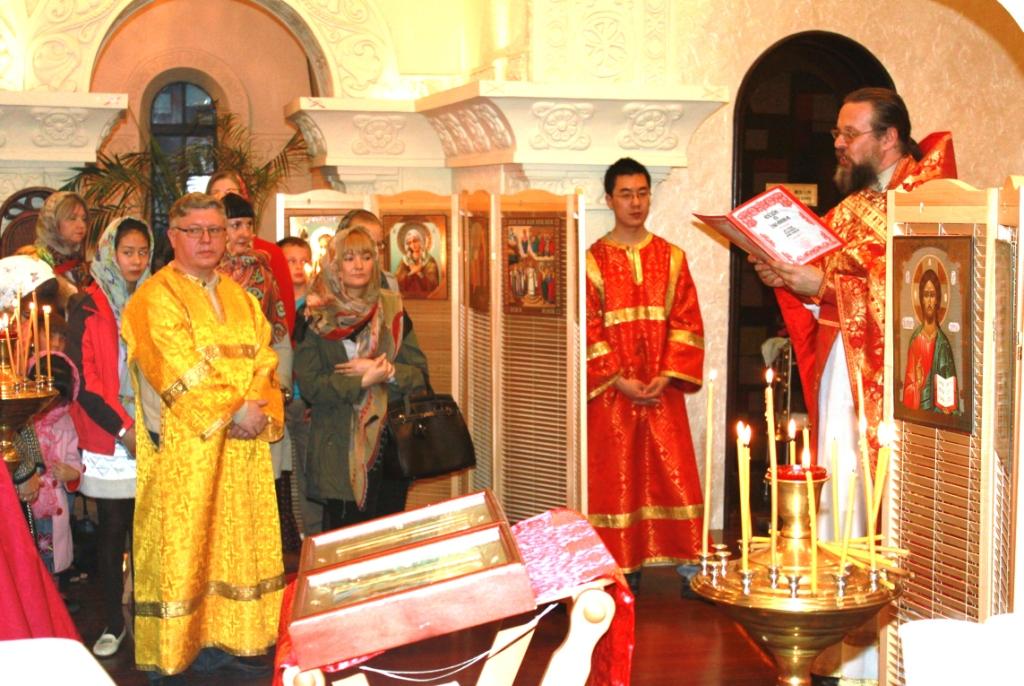
J-List has thousands of rare products from Japan - click now
Related Posts Plugin for WordPress, Blogger...