Showing posts with label Prayer. Show all posts

01 January 2013

2013 Holidays or Holy Days

Sorry it is late this year!

JANUARY
·         01/01 Circumcision of Jesus Christ
·         01/06 Holy Theophany
FEBRUARY
·         02/02 Presentation of the Lord in the Temple
·         02/17 Sunday of the Canaanite & Zacchaeus
·         02/24 Sunday of the Publican & Pharisee (Lenten Triodion Begins)
MARCH
·         03/03 Sunday of the Prodigal Son
·         03/09 1st Saturday of Souls
·         03/10 Meatfare Sunday of the Last Judgment
·         03/16 2nd Saturday of Souls
·         03/17 Cheesefare Sunday of Forgiveness
·         03/18 First Day of the Great Lent/Fast
·         03/23 3rd Saturday of Souls
·         03/24 Sunday of Orthodoxy
·         03/25 Holy Annunciation
·         03/31 Sunday of Saint Gregory Palamas
APRIL
·         04/07 Sunday of the Holy Cross
·         04/14 Sunday of Saint John Climacus
·         04/20 Saturday of the Akathist Hymn
·         04/21 Sunday of Saint Mary of Egypt
·         04/27 Lazarus Saturday
·         04/28 Palm/Willowy/Flowery Sunday of the Entrance into Jerusalem of the Lord
·         04/29 Great and Holy Monday
·         04/30 Great and Holy Tuesday
MAY
·         05/01 Great and Holy Wednesday
·         05/02 Great and Holy Thursday
·         05/03 Great and Holy Friday
·         05/04 Great and Holy Saturday
·         05/05 Great and Holy Pascha
·         05/06 Bright Monday of Renewal
·         05/07 Bright Tuesday of Renewal
·         05/08 Bright Wednesday of Renewal
·         05/09 Bright Thursday of Renewal
·         05/10 Bright Friday of Renewal
·         05/11 Bright Saturday of Renewal
·         05/12 Thomas Sunday of Antipascha
·         05/19 Sunday of the Myrrh-Bearing Women
·         05/26 Sunday of the Paralytic
·         05/29 Feast of Mid-Pentecost
JUNE
·         06/02 Sunday of the Samaritan Woman
·         06/09 Sunday of the Blind Man
·         06/12 Apodosis of Pascha
·         06/13 Holy Ascension
·         06/16 Sunday of the Fathers of the 1st Ecumenical Council
·         06/22 Saturday of Souls
·         06/23 Holy Pentecost
·         06/24 Day of the Holy Spirit
·         06/29 Feast of the Holy Apostles
·         06/30 Sunday of All Saints
JULY
·         07/14 Sunday of the Holy Fathers of the First 6 Ecumenical Councils
AUGUST
·         08/01 Beginning of the Dormition Lent/Fast
·         08/06 Holy Transfiguration
·         08/15 Dormition of the Theotokos
SEPTEMBER
·         09/01 Beginning of the Indiction, New Ecclesiastical Year 7522 of Creation
·         09/08 Nativity of the Theotokos
·         09/14 Elevation of the Holy Cross
OCTOBER
·         10/13 Sunday of the 7th Ecumenical Council
·         10/28 Holy Protection of the Theotokos
NOVEMBER
·         11/16 First Day of the Nativity Lent/Fast (Advent)
·         11/21 Presentation of the Theotokos in the Temple
DECEMBER
·         12/25 Holy Nativity


J-List has thousands of rare products from Japan - click now

12 July 2012

The Heresy of Racism

Want to add a useful word to your vocabulary? The term phyletism from phili: race or tribe was coined at the Holy and Great pan-Orthodox pan-Orthodox Synod that met in Istanbul (formerly Constantinople) in 1872. The meeting was prompted by the creation of a separate bishopric by the Bulgarian community of Istanbul for parishes only open to Bulgarians. It was the first time in Church history that a separate diocese was established based on ethnic identity rather than principles of Orthodoxy and territory. Here is the Synod’s official condemnation of ecclesiastical racism, or “ethno-phyletism,” as well as its theological argumentation. It was issued on the 10th of August 1872.


We renounce, censure and condemn racism, that is racial discrimination, ethnic feuds, hatreds and dissensions within the Church of Christ, as contrary to the teaching of the Gospel and the holy canons of our blessed fathers which “support the holy Church and the entire Christian world, embellish it and lead it to divine godliness.”
A section of the report drawn up by the special commission of the pan-Orthodox Synod of Constantinople in 1872 reviewed the general principles which guided the Synod in its condemnation.

The question of what basis racism that is discriminating on the basis of different racial origins and language and the claiming or exercising of exclusive rights by persons or groups of persons exclusively of one country or group can have in secular states lies beyond the scope of our inquiry. But in the Christian Church, which is a spiritual communion, predestined by its Leader and Founder to contain all nations in one brotherhood in Christ, racism is alien and quite unthinkable. Indeed, if it is taken to mean the formation of special racial churches, each accepting all the members of its particular race, excluding all aliens and governed exclusively by pastors of its own race, as its adherents demand, racism is unheard of and unprecedented.

All the Christian churches founded in the early years of the faith were local and contained the Christians of a specific town or a specific locality, without racial distinction. They were thus usually named after the town or the country, not after the ethnic origin of their people.

The Jerusalem Church consisted of Jews and proselytes from various nations. The Churches of Antioch, Alexandria, Ephesus, Rome and all the others were composed of Jews but mainly of gentiles. Each of these churches formed within itself an integral and indivisible whole. Each recognized as its Apostles the Apostles of Christ, who were all Jews. Each had a bishop installed by these Apostles without any racial discrimination: this is evident in the account of the founding of the first Churches of God….

The same system of establishing churches by locality prevails even after the Apostolic period, in the provincial or diocesan churches which were marked out on the basis of the political organization then prevailing, or of other historical reasons. The congregation of the faithful of each of these churches consisted of Christians of every race and tongue….

Paradoxically, the Church of Greece, Russia, Serbia, Moldavia and so on, or less properly the Russian Church, Greek Church, etc., mean autocephalous or semi-independent churches within autonomous or semi-independent dominions, with fixed boundaries identical with those of the secular dominions, outside which they have no ecclesiastical jurisdiction. They were composed not on ethnic grounds, but because of a particular situation, and do not consist entirely of one race or tongue. The Orthodox Church has never known racially-based churches… to coexist within the same parish, town or country…

If we examine those canons on which the Church’s government is constructed, we find nowhere in them any trace of racism. … Similarly, the canons of the local churches, when considering the formation, union or division of ecclesiastical groupings, put forward political reasons or ecclesiastical needs, never racial claims…. From all this, it is quite clear that racism finds no recognition in the government and sacred legislation of the Church.

But the racial principle also undermines the sacred governmental system of the Church…

In a racially organized church, the church of the local diocese has no area proper to itself, but the ethnic jurisdictions of the supreme ecclesiastical authorities are extended or restricted depending on the ebb and flow of peoples constantly being moved or migrating in groups or individually… If the racial principal is followed, no diocesan or patriarchal church, no provincial or metropolitan church, no episcopal church, not even a simple parish, whether it be the church of a village, small town or a suburb, can exist with its own proper place or area, containing within it all those of one faith. Is not Christ thus divided, as He was once among the Corinthians, by those who say: “I am for Paul, I am for Apollo, I am for Cephas” (1 Cor. 1:12)? …

No Ecumenical Council would find it right or in the interests of Christianity as a whole to admit an ecclesiastical reform [whose membership was based on ethnic identity] to serve the ephemeral idiosyncrasies of human passions and base concerns, because, apart from overthrowing the legislative achievements of so many senior Ecumenical Councils, it implies other destructive results, both manifest and potential:

First of all, it introduces a Judaic exclusiveness, whereby the idea of the race is seen a sine qua non of a Christian, particularly in the hierarchical structure. Every non-Greek, for instance, will thus be legally excluded from what will be called the Greek Church and hierarchy, every non-Bulgarian from the Bulgarian Church, and so on. As a Jew, St. Paul, the Apostle of the Gentiles, could only have been a pastor in one nation, the Jewish. Similarly, Saints Cyril and Methodius, being of Greek origin, would not have been accepted among the Slavs. What a loss this would have entailed for the Church! …

Thus the sacred and divine are rendered entirely human, secular interest is placed above spiritual and religious concerns, with each of the racial churches looking after its own. The doctrine of faith in “one Holy, Catholic and Apostolic Church” receives a mortal blow. If all this occurs, as indeed it has, racism is in open dispute and contradiction with the spirit and teaching of Christ.

Reprinted from “For the Peace from Above: an Orthodox Resource Book on War, Peace and Nationalism”, edited by Hildo Bos and Jim Forest (Syndesmos, 1999).


J-List has thousands of rare products from Japan - click now

06 May 2012

2012 Paschal Celebrations throughout China Have Grown Exponentially

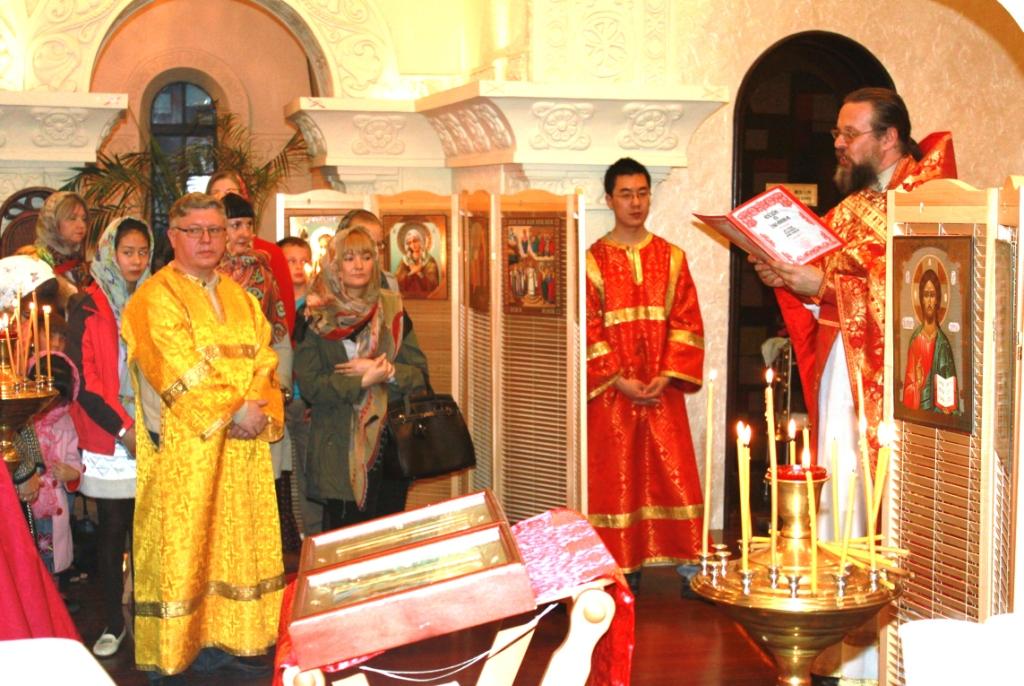
Worship at the Dormition Church-Museum on the territory of Russian Embassy in China during the Holy Week occurred daily. Rector of the Dormition Church priest Sergey Voronin was helped by cleric of Australian Diocese of the Russian Orthodox Church outside Russia, Fr Alexis Duke, and a cleric of the Orthodox Church of Czech Lands and Slovakia, Priest Igor Efremushkin.

At the Paschal liturgy more than 500 people came to pray. At the service were, in particular ambassadors and Minister-Counselors of Russia, Ukraine, Belarus, Greece, the Republic of Macedonia, diplomats from Moldova, Serbia and Montenegro. Parishioners were given the Gospel of Mark and a brochure about the Orthodox Church and church sacraments. During the liturgies of Holy Saturday and Pascha there were more than 200 communicants.

On April 22, 2012, the day of Antipascha (Saint Thomas Sunday), the Russian Cultural Center in Beijing had the Paschal celebration hosted by the Sunday School pupils of the Dormition Church.
On April 15, 2012 at St. Nicholas Church-Monument was held in Shanghai festive Paschal service, which was celebrated by the rector of the local Orthodox community Archpriest Alexei Kiselevich. Local authorities gave a permit to conduct church services, after a long delay: the last time the faithful gathered for prayer in this unique temple remaining from the first Russian emigration, was exactly one year ago. At this time, to celebrate the Orthodox Pascha, about 400 believers of various nationalities - Russian, Ukrainians, Belarusians, Serbs, Bulgarians, Romanians, Greeks, French, Dutch and others came to the church. Orthodox came from Dalian, Hangzhou, Suzhou, Nanjing, Ningbo, Guangzhou and other cities in China. Holy Communion was taken by more than 160 people. The service was attended by Consul General of Russia, Ukraine and Belarus, the leadership of the Russian Club in Shanghai. For the first time the Church could not accommodate everyone - a lot of people stood along the walls of the temple, awaiting the opportunity to venerate the icons, to go to confession, take the Holy Communion, blessing of cakes and eggs. Quite a large group of fellow countrymen during the service was forced to remain on the steps of the church and on the street. By 11 o'clock most of them due to lack of space, even moved into the roadway. Quiet Street Gaolan-lu became a piece of real Russia, and in areas adjacent to the temple one could hear primarily Russian speech. After the service a tea party was organized, there was a show of children's Paschal play, prepared by the pupils of the Sunday school "Kolosok."

Paschal services in Hong Kong were conducted by Fr Dionisy Pozdnyaev, the rector of Ss Peter and Paul Russian Orthodox Church parish. At the Paschal service there was more than a hundred people, 67 took the Holy Communion. Divine service was performed in Slavonic, English and Chinese, and the Gospel was read in an even greater number of languages.

At the services were the diplomats of General Consulates of Russia in Hong Kong and Guangzhou, as well as citizens of Ukraine, Belarus, Moldova, China, USA, France, Great Britain, Austria, Switzerland and Sweden. Among the worshipers were guests from Shenzhen, Guangzhou, Xiamen, Qingdao, Beijing, Zhuhai and Taiwan.

During Paschal evening prayers the worshippers were given the Gospel of Mark in Chinese, Slavonic, English, and Russian, published in Hong Kong by the care of parishes in Beijing, Shenzhen and Hong Kong to commemorate the 300th anniversary of the Beijing mission, and in commemoration of the Paschal liturgy. After the Paschal vespers, a concert of children's choir of the parish, was organized on the occasion of the Holy Resurrection of Christ.

During Bright Week there were Paschal services conducted in Shenzhen and Guangzhou. Worship in Guangzhou, which was celebrated by a cleric of Khabarovsk diocese Hieromonk Nicanor (Lepeshev), was attended by more than 50 people, which is considerably larger than last year.

J-List has thousands of rare products from Japan - click now

08 April 2012

Lazarus Saturday and Palm Sunday

Lazarus Saturday, in the Orthodox Church and those Eastern Catholic Churches which follow the Byzantine Rite, is the day before Palm Sunday, and is liturgically linked to it. The feast celebrates the resurrection of Lazarus of Bethany, the narrative of which is found in the New Testament Gospel of John (John 11:1-45). It is the first day of Holy Week.

Lazarus Saturday and Palm Sunday together hold a unique position in the church year, as days of joy and triumph interposed between the penitence of Great Lent and the mourning of Holy Week.

During the preceding week, which is the last week of Great Lent, the hymns in the Lenten Triodion track the sickness and then the death of Lazarus, and Christ's journey from beyond Jordan to Bethany. This week is referred to as the "Week of Palms" or the "Flowery Week."

The position of Lazarus Saturday is perfectly summed up in the first sticheron chanted at Vespers on Friday evening:
Having completed the forty days that bring profit to our soul, we beseech Thee in Thy love for man: Grant us also to behold the Holy Week of Thy Passion, that in it we may glorify Thy mighty acts and Thine ineffable dispensation for our sakes, singing with one mind: O Lord, glory to Thee.
During the Liturgy of the Presanctified Gifts on Friday evening, the reading of Genesis (which began on the first day of Great Lent) is concluded with the description of the death, burial and mourning of Jacob (Genesis 49:33-50:26), which corresponds perfectly with the message of Lazarus Saturday, deepening the sense of sorrow and hope. On Friday night, at Compline, the Canon on the Resurrection of Lazarus by Saint Andrew of Crete is read. This is a full canon, having all nine Canticles (most canons omit the Second Canticle).
The scripture readings and hymns for Lazarus Saturday focus on the resurrection of Lazarus as a foreshadowing of the Resurrection of Christ, and a promise of the General Resurrection. The Gospel narrative is interpreted in the hymns as illustrating the two natures of Christ: his humanity in asking, "Where have ye laid him?" (John 11:34), and his divinity by commanding Lazarus to come forth from the dead (John 11:43). A number of the hymns, written in the first or second person, relate Lazarus' death, entombment and burial bonds symbolically to the individual's sinful state. Many of the Resurrectional hymns of the normal Sunday service, which are omitted on Palm Sunday, are chanted on Lazarus Saturday. However, the Litany of the Departed, which is normally forbidden at the Sunday services, is allowed. During the Divine Liturgy, the Baptismal Hymn, "As many as have been baptized into Christ have put on Christ" (Romans 6:3), is sung in place of the Trisagion. In some churches, baptism of adult converts is held on this day.

Lazarus Saturday is the day when, traditionally, hermits would leave their retreats in the wilderness to return to the monastery for the Holy Week services. In many places in the Russian Church, the vestments and church hangings on this day and on Palm Sunday are green, denoting the renewal of life. In the Greek Church, it is customary on Lazarus Saturday to plait elaborate crosses out of palm leaves which will be used on Palm Sunday.

Although the forty days of Great Lent end on the day before Lazarus Saturday, the day is still observed as a fast day, with no meat or dairy products permitted. However, the fast is somewhat mitigated, and wine and oil are permitted. In Russia, it is traditional to eat caviar on Lazarus Saturday. In the Greek Orthodox Church, spice breads called Lazarakia are made and eaten on this day.

The antiquity of this commemoration is demonstrated by the homilies of St. John Chrysostom (349 - 407), St Augustine of Hippo Regia (354 - 430), and others. In the 7th and 8th centuries, special hymns and canons for the feast were written by St. Andrew of Crete, St. Cosmas of Maium and St. John Damascene, which are still sung to this day.

According to Eastern Orthodox Church tradition, sometime after the Resurrection of Christ, Lazarus was forced to flee Judea because of rumoured plots on his life and came to Cyprus. There he was appointed by Paul and Barnabas as the first bishop of Kittim (present-day Larnaka). He lived there for thirty more years and on his death was buried there for the second and last time.

Further establishing the apostolic nature of Lazarus' appointment was the story that the bishop's pallium was presented to Lazarus by the Virgin Mary, who had woven it herself. Such apostolic connections were central to the claims to autocephaly made by the bishops of Kittim—subject to the patriarch of Jerusalem—during the period 325–413. The church of Kittim was declared (or confirmed) self-governing in 413.

According to tradition, Lazarus never smiled during the thirty years after his resurrection, worried by the sight of unredeemed souls he had seen during his four-day stay in Hades. The only exception was, when he saw someone stealing a pot, he smilingly said: "the clay steals the clay."

In 890, a tomb was found in Larnaca bearing the inscription "Lazarus the friend of Christ". Emperor Leo VI of Byzantium had Lazarus' remains transferred to Constantinople in 898. The transfer was apostrophized by Arethas, bishop of Caesarea, and is commemorated by the Orthodox Church each year on October 17.

In recompense to Larnaca, Emperor Leo had the Church of St. Lazarus, which still exists today, erected over Lazarus' tomb. The marble sarcophagus can be seen inside the church under the Holy of Holies. On November 2, 1972, human remains in a marble sarcophagus under the altar were discovered during renovation works in the church at Larnaka, and were identified as part of the saint's relics.

After the sacking of Constantinople by the Franks during the Fourth Crusade in 1204, the Roman Catholic Crusaders stole and carried the saint's relics to Marseilles, France as part of "the booty of war".

Palm Sunday is a Christian moveable feast that falls on the Sunday before Easter. The feast commemorates Jesus' triumphal entry into Jerusalem, an event mentioned in all four canonical Gospels. (Mark 11:1–11, Matthew 21:1–11, Luke 19:28–44, and John 12:12–19).

In many Christian churches, Palm Sunday is marked by the distribution of palm leaves (often tied into crosses) to the assembled worshipers. The difficulty of procuring palms for that day's ceremonies in unfavorable climates for palms led to the substitution of boughs of box, yew, willow, or other native trees. The Sunday was often designated by the names of these trees, as Willow Sunday, Yew Sunday, or Flowery Sunday.

In the accounts of the four canonical Gospels, Jesus' triumphal entry into Jerusalem takes place about a week before his Resurrection.

According to the Gospels, Jesus rode a donkey into Jerusalem, and the celebrating people there lay down their cloaks in front of him, and also lay down small branches of trees. The people sang part of Psalms 118: 25–26 – ... Blessed is He who comes in the name of the Lord. We bless you from the house of the Lord ....

The symbolism of the donkey may refer to the Eastern tradition that it is an animal of peace, versus the horse, which is the animal of war. Therefore, a king came riding upon a horse when he was bent on war and rode upon a donkey when he wanted to point out he was coming in peace. Therefore, Jesus' entry to Jerusalem symbolized his entry as the Prince of Peace, not as a war-waging king.

In many lands in the ancient Near East, it was customary to cover in some way the path of someone thought worthy of the highest honour. The Hebrew Bible (2Kings 9:13) reports that Jehu, son of Jehoshaphat, was treated this way. Both the Synoptic Gospels and the Gospel of John report that people gave Jesus this form of honour. However, in the synoptics they are only reported as laying their garments and cut rushes on the street, whereas John more specifically mentions palm fronds. The palm branch was a symbol of triumph and victory in Jewish tradition, and is treated in other parts of the Bible as such (e.g., Leviticus 23:40 and Revelation 7:9). Because of this, the scene of the crowd greeting Jesus by waving palms and carpeting his path with them and their cloaks has become symbolic and important.

In some of the Orthodox Church, Palm Sunday is often called the "Entry of the Lord into Jerusalem", is one of the Twelve Great Feasts of the liturgical year, and is the beginning of Holy Week. The day before is known as Lazarus Saturday, and commemorates the resurrection of Lazarus from the dead. Unlike the West, Palm Sunday is not considered to be a part of Lent, the Eastern Orthodox Great Fast ends on the Friday before. Lazarus Saturday, Palm Sunday and Holy Week are considered to be a separate fasting period. On Lazarus Saturday, believers often prepare palm fronds by knotting them into crosses in preparation for the procession on Sunday. The hangings and vestments in the church are changed to a festive color - gold in the Greek tradition and green in the Slavic tradition.

The Troparion of the Feast indicates the resurrection of Lazarus is a prefiguration of Jesus' own Resurrection:
O Christ our God
When Thou didst raise Lazarus from the dead before Thy Passion,
Thou didst confirm the resurrection of the universe.
Wherefore, we like children,
carry the banner of triumph and victory,
and we cry to Thee, O Conqueror of Death,
Hosanna in the highest!
Blessed is He that cometh
in the Name of the Lord.
In the Russian Orthodox Church, Ukrainian Orthodox Church, Ukrainian Catholic Church, Ruthenian Catholic Church, Polish, Bavarian and Austrian Roman Catholics, and various other Eastern European peoples, the custom developed of using pussy willow instead of palm fronds because the latter are not readily available that far north. There is no canonical requirement as to what kind of branches must be used, so some Orthodox believers use olive branches. Whatever the kind, these branches are blessed and distributed together with candles either during the All-Night Vigil on the Eve of the Feast (Saturday night), or before the Divine Liturgy on Sunday morning. The Great Entrance of the Divine Liturgy commemorates the "Entry of the Lord into Jerusalem", so the meaningfulness of this moment is punctuated on Palm Sunday as everyone stands, holding their branches and lit candles. The faithful take these branches and candles home with them after the service, and keep them in their icon corner as an evloghia (blessing).

In Russia, donkey walk processions took place in different cities, but most importantly in Novgorod and, since 1558 until 1693, in Moscow. It was prominently featured in testimonies by foreign witnesses and mentioned in contemporary Western maps of the city. The Patriarch of Moscow, representing Christ, rode on a "donkey" (actually a horse draped in white cloth); the Tsar of Russia humbly led the procession on foot. Originally, Moscow processions began inside the Kremlin and terminated at Trinity Church, now known as Saint Basil's Cathedral, but in 1658 Patriarch Nikon reversed the order of procession. Peter I, as a part of his nationalisation of the church, terminated the custom; it has been occasionally recreated in the 21st century.

In Oriental Orthodox churches, palm fronds are distributed at the front of the church at the sanctuary steps, in India the sanctuary itself having been strewn with marigolds, and the congregation proceeds through and outside the church.

J-List has thousands of rare products from Japan - click now

11 March 2012

Apotheosis in Religions of the World

Apotheosis (from Greek ἀποθέωσις from ἀποθεοῦν, apotheoun "to deify"; in Latin deificatio "making divine") is the glorification of a subject to divine level. The term has meanings in theology, where it refers to a belief, and in art, where it refers to a genre.

In theology, the term apotheosis refers to the idea that an individual has been raised to godlike stature. In art, the term refers to the treatment of any subject (a figure, group, locale, motif, convention or melody) in a particularly grand or exalted manner.

Prior to the Hellenistic period, imperial cults were known in Ancient Egypt (pharaohs) and Mesopotamia (since Naram-Sin). From the New Kingdom, all deceased pharaohs were deified as Osiris.

From at least the Geometric period of the ninth century BC, the long-deceased heroes linked with founding myths of Greek sites were accorded chthonic rites in their heroon, or "hero-temple".

In the Greek world, the first leader who accorded himself divine honours was Philip II of Macedon, who was a king, when the Greeks had set kingship aside, and who had extensive economic and military ties, though largely antagonistic, with Achaemenid Persia, where kings were divine. At his wedding to his sixth wife, Philip's enthroned image was carried in procession among the Olympian gods; "his example at Aigai became a custom, passing to the Macedonian kings who were later worshipped in Greek Asia, from them to Julius Caesar and so to the emperors of Rome". Such Hellenistic state leaders might be raised to a status equal to the gods before death (e.g., Alexander the Great) or afterwards (e.g., members of the Ptolemaic dynasty). Heroic cult similar to apotheosis was also an honour given to a few revered artists of the distant past, notably Homer.

Archaic and Classical Greek hero-cults became primarily civic, extended from their familial origins, in the sixth century; by the fifth century none of the worshipers based their authority by tracing descent back to the hero, with the exception of some families who inherited particular priestly cult, such as the Eumolpides (descended from Eumolpus) of the Eleusinian mysteries, and some inherited priesthoods at oracle sites. The Greek hero cults can be distinguished on the other hand from the Roman cult of dead emperors, because the hero was not thought of as having ascended to Olympus or become a god: he was beneath the earth, and his power purely local. For this reason hero cults were chthonic in nature, and their rituals more closely resembled those for Hecate and Persephone than those for Zeus and Apollo. Two exceptions were Heracles and Asclepius, who might be honored as either gods or heroes, sometimes by chthonic night-time rites and sacrifice on the following day.

Apotheosis in ancient Rome was a process whereby a deceased ruler was recognized as having been divine by his successor, usually also by a decree of the Senate and popular consent. In addition to showing respect, often the present ruler deified a popular predecessor to legitimize himself and gain popularity with the people. The upper-class did not always take part in the imperial cult, and some privately ridiculed the apotheosis of inept and feeble emperors, as in the satire The Pumpkinification of (the Divine) Claudius, usually attributed to Seneca. At the height of the imperial cult during the Roman Empire, sometimes the emperor's deceased loved ones—heirs, empresses, or lovers, as Hadrian's Antinous—were deified as well. Deified people were awarded posthumously the title Divus (Diva if women) to their names to signify their divinity. Traditional Roman religion distinguished between a deus (god) and a divus (a mortal who became divine or deified), though not consistently. Temples and columns were sometimes erected to provide a space for worship.

The Chinese Ming dynasty epic Investiture of the Gods deals heavily with deification legends. Numerous mortals have been deified into the Daoist pantheon, such as Guan Yu, Iron-crutch Li and Fan Kuai. Song Dynasty General Yue Fei was deified during the Ming Dynasty and is considered by some practitioners to be one of the three highest ranking heavenly generals.

Various Hindu and Buddhist rulers in the past have been represented as deities, especially after death, from Thailand to Indonesia. Even several Sultans of Yogyakarta were semi-deified, posthumously.

Instead of the word "apotheosis", Christian theology uses in English the words "deification" or "divinization" or the Greek word "theosis". Traditional mainstream theology, both East and West, views Jesus Christ as the pre-existing God who undertook mortal existence, not as a mortal being who attained divinity. It holds that he has made it possible for human beings to be raised to the level of sharing the divine nature: he became one of us to make us "partakers of the divine nature." "For this is why the Word became man, and the Son of God became the Son of man: so that man, by entering into communion with the Word and thus receiving divine sonship, might become a son of God." "For the Son of God became man so that we might become God." "The only-begotten Son of God, wanting to make us sharers in his divinity, assumed our nature, so that he, made man, might make men gods."

Christian theology traditionally makes a distinction between "theosis" and "apotheosis". Orthodox Trinitarian Christianity views Jesus Christ as the pre-existing God who undertook mortal existence, not a mortal being who attained divinity. Regarding human beings, the mystical theology of the Eastern Orthodox churches and Eastern Catholic churches characteristically describes the situation as "theosis", a Greek word.

Corresponding to the Greek word theosis are the Latin-derived words "divinization" and "deification" used in the parts of the Catholic Church that are of Latin tradition. The concept has been given less prominence in Western theology than in that of the Eastern Catholic Churches, but is present in the Latin Church's liturgical prayers, such as that of the deacon or priest when pouring wine and a little water into the chalice: "By the mystery of this water and wine may we come to share in the divinity of Christ who humbled himself to share in our humanity." The Catechism of the Catholic Church quotes with approval Saint Augustine's saying, "The Son of God became man so that we might become God."

Catholic theology stresses the concept of supernatural life, "a new creation and elevation, a rebirth, it is a participation in and partaking of the divine nature" (cf. 2 Peter 1:4). In Catholic teaching there is a vital distinction between natural life and supernatural life, the latter being "the life that God, in an act of love, freely gives to human beings to elevate them above their natural lives" and which they receive through prayer and the sacraments; indeed the Catholic Church sees human existence as having as its whole purpose the acquisition, preservation and intensification of this supernatural life.

J-List has thousands of rare products from Japan - click now

04 March 2012

The Antichrist!

The term or title antichrist, in Christian theology, refers to a leader who fulfills Biblical prophecies concerning an adversary of Christ, while resembling him in a deceptive manner. The antichrist will seemingly provide for the needs of the people but deny them ultimate salvation.

The term "antichrist" appears five times in 1 John and 2 John of the New Testament—once in plural form and four times in the singular. The Apostle Paul's Second Epistle to the Thessalonians, in particular the 2nd chapter, summarizes the nature, work, coming, and revelation of the "Man of Sin"—a passage often regarded as referring to same person as the antichrist of 1 and 2 John.

"Antichrist" is the English translation of the Koine Greek ἀντίχριστος (pronounced [anˈtikʰristos]). It is made up of two roots: αντί + Χριστός (anti + Christos). "Αντί" can mean not only "against" and "opposite of", but also "in place of", "Χριστός", translated "Christ", is Greek for the Hebrew "Messiah" meaning "anointed," and refers to Jesus of Nazareth within Christian, Islamic and Messianic Jewish theology.

The words antichrist and antichrists appear four times in the First and Second Epistle of Saint John. The word is not capitalized in most English translations of the Bible, including the original King James Version. 1 John chapter 2 refers to many antichrists present at the time while warning of one Antichrist that is coming. The "many antichrists" belong to the same spirit as that of the one Antichrist. John wrote that such antichrists "deny that Jesus is the Christ", "deny the Father and the Son", and would "not confess Jesus came in the flesh": a probable reference to the Docetic view that Jesus was not human, but only a spirit.

Some commentators, both ancient and modern, identify the Man of Sin in 2 Thessalonians chapter 2 as the Antichrist, even though they vary greatly in who they view the Antichrist to be. They argue that Paul uses the term "Man of Sin" (sometimes translated son of perdition or man of lawlessness) to describe what John identifies as the Antichrist.

Saint Paul writes that this Man of Sin will possess a number of characteristics. These include "sitting in the temple", opposing himself against anything that is worshiped, claiming divine authority, working all kinds of counterfeit miracles and signs, and doing all kinds of evil. Paul notes that "the mystery of lawlessness" (though not the Man of Sin himself) was working in secret already during his day and will continue to function until being destroyed on the Last Day. His identity is to be revealed after that which is restraining him (a possible reference to the katechon) is removed.

The term is also sometimes applied to prophecies regarding a "Little horn" power in Daniel 7. Daniel 9:27 mentions an "abomination that causes desolations" setting itself up in a "wing" or a "pinnacle" of the temple. Some scholars interpret this as referring to the Antichrist. Some commentators also view the verses prior to this as referring to the Antichrist. Jesus references the abomination from Daniel 9:27 in Matthew 24:15 and Mark 13:14 when he warns about the destruction of Jerusalem. Daniel 11:36-37 speaks of a self exalting king, considered by some to be the Antichrist.

Bernard McGinn described multiple traditions detailing the relationship between the Antichrist and Satan. In the dualist approach, Satan will become incarnate in the Antichrist, just as God became incarnate in Jesus. However, in orthodox Christian thought, this view was problematic because it was too similar to Christ's incarnation. Instead, the "indwelling" view became more accepted. It stipulates that the Antichrist is a human figure inhabited by Satan, since the latter’s power is not to be seen as equivalent to God’s.

Several American evangelical and fundamentalist theologians, including Cyrus Scofield, have identified the Antichrist as being in league with (or the same as) several figures in the Book of Revelation including the Dragon (or Serpent), the Beast, the False Prophet, and the Whore of Babylon. Others, for example, Rob Bell, reject the identification of the Antichrist with any one person or group. They believe a loving Christ would not view anyone as an enemy. Technically seen the antichrist is John's prophecy of an other religion that would spring up out of the old one, exactly and explicitly negating what Christ in the perception of Christians is.

As Saint John said: He who does not believe Christ came into the flesh as Son of God, is the antichrist.

Anti-messiahs are referred to in some Jewish writings in the period 500 BC–50 AD, and this is thought to be the precursor of the concept of the Antichrist in Christian writing. Bernard McGinn conjectures that the concept may have been generated by the frustration of Jews subject to often-capricious Seleucid or Roman rule, who found the nebulous Jewish idea of a Satan who is more of an opposing angel of God in the heavenly court insufficiently humanised and personalised to be a satisfactory incarnation of evil and threat. Armilus is an anti-messiah figure from late period Jewish eschatology. He is described as bald, partially maimed, and partially deaf.

Polycarp (ca. 69 – ca. 155) warned the Philippians that everyone that preached false doctrine was an antichrist.

Irenaeus (2nd century AD – c. 202) held that Rome, the fourth prophetic kingdom, would end in a tenfold partition. The ten divisions of the empire are the "ten horns" of Daniel 7 and the "ten horns" in Revelation 17. A "little horn", which is to supplant three of Rome's ten divisions, is also the still future "eighth" in Revelation.

Irenaeus identified the Antichrist with Paul's Man of Sin, Daniel's Little Horn, and John's Beast of Revelation 13. He sought to apply other expressions to Antichrist, such as "the abomination of desolation," mentioned by Christ (Matt. 24:15) and the "king of a most fierce countenance," in Gabriel's explanation of the Little Horn of Daniel 8.

Under the notion that the Antichrist, as a single individual, might be of Jewish origin, Irenaeus fancies that the mention of "Dan," in Jeremiah 8:16, and the omission of that name from those tribes listed in Revelation 7, might indicate Antichrist's tribe. He also speculated that it was "very probable" the Antichrist might be called Lateinos, which is Greek for "Latin Man".

Tertullian (ca.160 – ca.220 AD) held that the Roman Empire was the restraining force written about by Paul in 2 Thessalonians 2:7-8. The fall of Rome and the disintegration of the ten provinces of the Roman Empire into ten kingdoms were to make way for the Antichrist.

'For that day shall not come, unless indeed there first come a falling away,' he [Paul] means indeed of this present empire, 'and that man of sin be revealed,' that is to say, Antichrist, 'the son of perdition, who opposeth and exalteth himself above all that is called God or religion; so that he sitteth in the temple of God, affirming that he is God. Remember ye not, that when I was with you, I used to tell you these things? And now ye know what detaineth, that he might be revealed in his time. For the mystery of iniquity doth already work; only he who now hinders must hinder, until he be taken out of the way.' What obstacles is there but the Roman state, the falling away of which, by being scattered into the ten kingdoms, shall introduce Antichrist upon (its own ruins)? And then shall be revealed the wicked one, whom the Lord shall consume with the spirit of His mouth, and shall destroy with the brightness of His coming: even him whose coming is after the working of Satan, with all power, and signs, and lying wonders, and with all deceivableness of unrighteousness in them that perish.'

Hippolytus of Rome (c. 170-c. 236) held that the Antichrist would come from the tribe of Dan and would rebuild the Jewish temple in order to reign from it. He identified the Antichrist with the Beast out of the Earth from the book of Revelation.

By the beast, then, coming up out of the earth, he means the kingdom of Antichrist; and by the two horns he means him and the false prophet after him. And in speaking of "the horns being like a lamb," he means that he will make himself like the Son of God, and set himself forward as king. And the terms, "he spake like a dragon," mean that he is a deceiver, and not truthful.

Origen (185–254) refuted Celsus's view of the Antichrist. Origen utilized Scriptural citations from Daniel, Paul, and the Gospels. He argued:
Where is the absurdity, then, in holding that there exist among men, so to speak, two extremes-- the one of virtue, and the other of its opposite; so that the perfection of virtue dwells in the man who realizes the ideal given in Jesus, from whom there flowed to the human race so great a conversion, and healing, and amelioration, while the opposite extreme is in the man who embodies the notion of him that is named Antichrist?... one of these extremes, and the best of the two, should be styled the Son of God, on account of His pre-eminence; and the other, who is diametrically opposite, be termed the son of the wicked demon, and of Satan, and of the devil. And, in the next place, since evil is specially characterized by its diffusion, and attains its greatest height when it simulates the appearance of the good, for that reason are signs, and marvels, and lying miracles found to accompany evil, through the cooperation of its father the devil.
Athanasius (c. 293 – 373), writes that Arius of Alexandria is to be associated with the Antichrist, saying, "And ever since [the Council of Nicaea] has Arius's error been reckoned for a heresy more than ordinary, being known as Christ's foe, and harbinger of Antichrist."

John Chrysostom (c. 347–407) warned against speculations and old wives' tales about the Antichrist, saying, "Let us not therefore enquire into these things". He preached that by knowing Paul's description of the Antichrist in 2 Thessalonians Christians would avoid deception.

Jerome (c. 347-420) warned that those substituting false interpretations for the actual meaning of Scripture belonged to the "synagogue of the Antichrist". "He that is not of Christ is of Antichrist," he wrote to Pope Damasus I. He believed that "the mystery of iniquity" written about by Paul in 2 Thessalonians 2:7 was already in action when "every one chatters about his views." To Jerome, the power restraining this mystery of iniquity was the Roman Empire, but as it fell this restraining force was removed. He warned a noble woman of Gaul:
"He that letteth is taken out of the way, and yet we do not realize that Antichrist is near. Yes, Antichrist is near whom the Lord Jesus Christ "shall consume with the spirit of his mouth." "Woe unto them," he cries, "that are with child, and to them that give suck in those days."... Savage tribes in countless numbers have overrun run all parts of Gaul. The whole country between the Alps and the Pyrenees, between the Rhine and the Ocean, has been laid waste by hordes of Quadi, Vandals, Sarmatians, Alans, Gepids, Herules, Saxons, Burgundians, Allemanni, and—alas! for the commonweal!-- even Pannonians.
In his Commentary on Daniel, Jerome noted, "Let us not follow the opinion of some commentators and suppose him to be either the Devil or some demon, but rather, one of the human race, in whom Satan will wholly take up his residence in bodily form." Rebuilding the Jewish Temple to reign from, Jerome thought the Antichrist sat in God’s Temple inasmuch as he made "himself out to be like God." He refuted Porphyry’s idea that the "little horn" mentioned in Daniel chapter 7 was Antiochus Epiphanes by noting that the "little horn" is defeated by an eternal, universal ruler, right before the final judgment. Instead, he advocated that the "little horn" was the Antichrist:
We should therefore concur with the traditional interpretation of all the commentators of the Christian Church, that at the end of the world, when the Roman Empire is to be destroyed, there shall be ten kings who will partition the Roman world amongst themselves. Then an insignificant eleventh king will arise, who will overcome three of the ten kings... after they have been slain, the seven other kings also will bow their necks to the victor.
Circa 380, an apocalyptic pseudo-prophecy falsely attributed to the Tiburtine Sibyl describes Constantine as victorious over Gog and Magog. Later on, it predicts:
When the Roman empire shall have ceased, then the Antichrist will be openly revealed and will sit in the House of the Lord in Jerusalem. While he is reigning, two very famous men, Elijah and Enoch, will go forth to announce the coming of the Lord. Antichrist will kill them and after three days they will be raised up by the Lord. Then there will be a great persecution, such as has not been before nor shall be thereafter. The Lord will shorten those days for the sake of the elect, and the Antichrist will be slain by the power of God through Michael the Archangel on the Mount of Olives.
Augustine of Hippo (354 – 430) wrote "it is uncertain in what temple [the Antichrist] shall sit, whether in that ruin of the temple which was built by Solomon, or in the Church."

Pope Gregory I wrote to Emperor Maurice A.D. 597, concerning the titles of bishops, "I say with confidence that whoever calls or desires to call himself ‘universal priest’ in self-exaltation of himself is a precursor of the Antichrist."

After the reforms of Patriarch Nikon to the Russian Orthodox Church of 1652, a large number of Old Believers held that czar Peter the Great was the Antichrist because of his treatment of the Orthodox Church, namely subordinating the church to the state, requiring clergymen to conform to the standards of all Russian civilians (shaved beards, being fluent in French), and requiring them to pay state taxes.

The view of Futurism, a product of the Counter-Reformation, was advanced beginning in the 16th century in response to the identification of the Papacy as Antichrist. Francisco Ribera, a Jesuit priest, developed this theory in In Sacrum Beati Ioannis Apostoli, & Evangelistiae Apocalypsin Commentarij, his 1585 treatise on the Apocalypse of John. St. Bellarmine codified this view, giving in full the Catholic theory set forth by the Greek and Latin Fathers, of a personal Antichrist to come just before the end of the world and to be accepted by the Jews and enthroned in the temple at Jerusalem — thus endeavoring to dispose of the exposition which saw Antichrist in the pope. Most premillennial dispensationalists now accept Bellarmine's interpretation in modified form.

Widespread Protestant identification of the Papacy as the Antichrist persisted in the USA until the early 1900s when the Scofield Reference Bible was published by Cyrus Scofield. This commentary promoted Futurism, causing a decline in the Protestant identification of the Papacy as Antichrist.

Some US Futurists hold that sometime prior to the expected return of Jesus, there will be a period of "great tribulation" during which the Antichrist, indwelt and controlled by Satan, will attempt to win supporters with false peace, supernatural signs. He will silence all that defy him by refusing to "receive his mark" on their right hands or forehead. This "mark" will be required to legally partake in the end-time economic system. Some Futurists believe that the Antichrist will be assassinated half way through the Tribulation, being revived and indwelt by Satan. The Antichrist will continue on for three and a half years following this "deadly wound".

Bernard McGinn noted that complete denial of the Antichrist was rare until the Enlightenment. Following frequent use of "Antichrist" laden rhetoric during religious controversies in the 17th century, the use of the concept declined in the 18th century. Subsequent eighteenth-century efforts to cleanse Christianity of "legendary" or "folk" accretions effectively removed the Antichrist from discussion in the new modernistic mainstream Western churches.

Masih Ad-Dajjal (Arabic: الدّجّال‎, literally "The Deceiving Messiah"), is an evil figure in Islamic eschatology. He is to appear pretending to be God at a time in the future, before Yawm al-Qiyamah (The Day of Resurrection, Judgment Day). He will travel around the globe entering every city except Mecca and Medina obliging people to believe in him as a God. Then Isa (Jesus) will descend from the sky to the White lighthouse in eastern Damascus, Syria, placing his hands on the backs of two angels at the time of Fajr. This will happen at the time of the Dajjal and Isa will be the one to eventually defeat the Dajjal, killing him with his spear.

The Ahmadiyya teachings interpret the prophecies regarding the appearance of the Dajjal (Anti-Christ) and Gog and Magog in Islamic eschatology as foretelling the emergence of two branches or aspects of the same turmoil and trial that was to be faced by Islam in the latter days and that both emerged from Christianity or Christian nations. Its Dajjal aspect relates to deception and perversion of religious belief while its aspect to do with disturbance in the realm of politics and the shattering of world peace has been called Gog and Magog. Thus Ahmadis consider the widespread Christian missionary activity that was 'aggressively' active in the 18th and 19th centuries as being part of the prophesied Dajjal (Antichrist) and Gog and Magog emerging in modern times. The emergence of the Soviet Union and the USA as superpowers and the conflict between the two nations (i.e., the rivalry between communism and capitalism) are seen as having occurred in accordance with certain prophecies regarding Gog and Magog. Thus, Ahmadis believe that prophecies and sayings about the Antichrist are not to be interpreted literally. They have a deeper meanings. Masih ad-Dajjal is then a name to given to latter day Christianity and the west.

In the Alice A. Bailey material, Theosophist Alice A. Bailey asserts that World War II was a cosmic conflict between good and evil. The Masters of the Wisdom, representing the Forces of Light, were on the side of the Allies; the Dark Forces were on the side of the Axis. According to Bailey, Adolf Hitler was possessed by the Dark Forces. With the defeat of the axis by the allies in 1945, the stage was set for the appearance of Maitreya to inaugurate the New Age. Alice A. Bailey's follower Benjamin Creme claims to be the one called to prepare the way for this to happen, and that it is possible that it could happen because Adolf Hitler was the Anti-Christ and he was defeated in World War II.

J-List has thousands of rare products from Japan - click now
Related Posts Plugin for WordPress, Blogger...